
Post Summary
What is polished concrete and how is it different from ordinary sealed or coated concrete?
Polished concrete is mechanically ground and refined concrete — the floor surface itself transformed through progressive diamond tooling and chemical densification rather than coated or covered with a separate material. The distinction is fundamental: epoxy coatings and other floor systems sit on top of the concrete and can peel, chip, and require periodic replacement. Polished concrete is the concrete, refined to a higher density and surface quality through a multi-step process that hardens the surface by up to 40 percent, reduces dusting, improves stain resistance, and creates a reflective finish. Because the polished surface is the concrete itself rather than a coating over it, normal wear maintains rather than damages it in high-traffic areas, and there is no coating layer to fail, delaminate, or require reapplication across the floor’s service life.
What does the polished concrete installation process involve and how do the steps affect the final result?
Polished concrete installation follows a defined sequence where each step determines what is possible in the next. Surface preparation and repair — crack filling, joint addressing, coating removal, and damage patching — establishes the foundation quality that no subsequent polishing can improve upon. Coarse grinding at 30 to 80 grit removes the surface cream layer and initial imperfections; medium grinding at 100 to 200 grit refines the surface; fine grinding at 400 plus grit prepares for polishing. Densification with lithium, sodium, or potassium silicate chemistry reacts with concrete’s calcium hydroxide to create calcium silicate hydrate — filling pores, hardening the surface by up to 40 percent, and creating the harder substrate that polishing refines. Polishing with resin-bonded diamond tooling at progressively finer grits — typically 800, 1500, and 3000 — builds from satin finish to mirror-like high gloss depending on the final grit achieved. Optional stains, dyes, guards, and anti-slip treatments complete the system for applications with specific aesthetic or traction requirements.
What are the CPAA exposure levels for polished concrete and how does the choice affect cost and appearance?
The Concrete Polishing Association of America classifies polished concrete by how much aggregate is visible after grinding. Class A, or cream and ground, produces minimal aggregate exposure with a relatively uniform appearance using the lightest grinding approach. Class B, fine aggregate, reveals small aggregate producing the salt-and-pepper appearance that is the most common commercial specification. Class C, medium aggregate, exposes one-quarter to one-half inch aggregate creating a more dramatic and varied surface. Class D, large aggregate, produces maximum exposure with a terrazzo-like appearance featuring larger visible stones. Higher exposure levels require more aggressive grinding — increasing both labor cost and time — and depend on the concrete mix containing suitable aggregate to reveal. A slab poured with basic aggregate cannot produce a Class D appearance regardless of grinding depth. The exposure level decision shapes the floor’s entire aesthetic character and should be made with knowledge of the slab’s aggregate composition before any specification commitment is made.
What are the honest limitations of polished concrete and when should alternative flooring systems be specified instead?
Polished concrete is an exceptional system for the right applications and an inappropriate specification for others. Chemical resistance is the most significant limitation — polished concrete handles many industrial chemicals, but aggressive acids, solvents, and caustics require epoxy or urethane cement systems that provide a chemical-resistant coating barrier rather than relying on the densified concrete surface alone. Thermal shock from hot washdowns or rapid temperature changes can damage polished concrete surfaces, making it an incorrect specification for food processing wet areas, CIP environments, and pharmaceutical manufacturing spaces where washdown protocols are routine. Poor-quality, thin, or heavily damaged slabs may not produce acceptable polished results regardless of contractor skill. High-gloss polished concrete becomes slippery when wet, which may not meet traction requirements for certain environments without anti-slip treatment. Seamless coved systems required in food processing and pharmaceutical facilities cannot be achieved with polished concrete.
How does polished concrete compare to epoxy coatings and VCT in total cost of ownership over a 10 to 20 year horizon?
Polished concrete’s total cost advantage over both alternatives becomes clear when maintenance costs are included alongside installation costs. Epoxy coatings have lower initial cost in many applications but require periodic recoating as the system wears — each recoating event adds material, labor, and facility downtime cost that polished concrete does not incur after initial installation. VCT carries lower initial installation cost but requires continuous maintenance: regular waxing, periodic stripping, and eventual replacement — a maintenance program that many facilities find costs 30 to 50 percent more annually than polished concrete maintenance. Over a 20-year horizon, polished concrete typically costs less than either alternative when maintenance is factored in — while delivering better appearance consistency throughout that period, since polished concrete does not develop the wear patterns and wax buildup that VCT shows over years of use.
Walk into any modern warehouse, distribution center, or retail space, and chances are you’re standing on polished concrete. This flooring system has transformed from a utilitarian afterthought into one of the most popular choices for commercial and industrial facilities—and for good reason.
At Summit Industrial Flooring, we’ve been polishing concrete for over three decades. We’ve seen the technology evolve from basic grinding to sophisticated multi-step systems that rival the aesthetics of any finished flooring material. This guide covers everything facility managers and building owners need to know about polished concrete flooring.
What Is Polished Concrete?
Polished concrete is exactly what it sounds like: a concrete floor that has been mechanically ground and polished to achieve a smooth, high-gloss finish. But calling it “just polished” undersells the process. Modern polished concrete involves multiple grinding stages with progressively finer diamond tooling, chemical densifiers that harden the surface, and optional stains or dyes for aesthetic customization.
The result is a floor that’s harder, denser, and more reflective than ordinary concrete—while remaining incredibly durable and low-maintenance.
The Polished Concrete Process: Step by Step
Understanding how polished concrete is created helps explain why quality varies so dramatically between contractors. Here’s what goes into a properly executed installation:
1. Surface Preparation and Repair
Before any grinding begins, the concrete must be evaluated and prepared. This includes:
- Crack repair—Filling cracks with appropriate materials that will polish similarly to the surrounding concrete
- Joint filling—Addressing control joints and saw cuts
- Patching—Repairing spalls, holes, and damaged areas
- Coating removal—If existing coatings are present, they must be completely removed
The quality of surface preparation directly affects the final appearance. Rushed prep work leads to visible imperfections that no amount of polishing can hide.
2. Grinding (Cutting)
The grinding process uses progressively finer diamond-impregnated tooling to smooth the concrete surface and expose aggregate (if desired). This typically involves:
- Coarse grinding—30 to 80 grit diamonds remove the cream layer and initial imperfections
- Medium grinding—100 to 200 grit diamonds refine the surface
- Fine grinding—400+ grit diamonds prepare the surface for polishing
The depth of grinding determines how much aggregate (the stones in the concrete mix) is exposed. More aggressive grinding reveals larger stones for a terrazzo-like appearance, while lighter grinding maintains a more uniform look.
3. Densification
After initial grinding, a liquid chemical densifier is applied to the concrete. This typically contains lithium, sodium, or potassium silicates that react with the calcium hydroxide in concrete to create calcium silicate hydrate—a compound that fills pores and hardens the surface.
Densification is critical because it:
- Hardens the concrete surface by up to 40%
- Reduces dusting by sealing pores
- Improves stain resistance
- Creates a better foundation for polishing
4. Polishing
With the surface densified, polishing begins using resin-bonded diamond tooling at increasingly fine grits—typically 800, 1500, and 3000. Each pass creates a progressively higher sheen. The final grit determines the reflectivity:
- 400 grit—Satin or matte finish with low reflectivity
- 800 grit—Low-sheen finish with slight reflection
- 1500 grit—Medium sheen, visible reflections
- 3000+ grit—High-gloss, mirror-like finish
5. Optional Treatments
Depending on the application, additional treatments may be applied:
- Stains and dyes—For colored or decorative finishes
- Guards and sealers—For additional stain protection in high-traffic or food service areas
- Anti-slip treatments—If traction requirements exceed the natural slip resistance
Exposure Levels: What They Mean
The Concrete Polishing Association of America (CPAA) classifies polished concrete by exposure level—how much aggregate is visible:
- Class A (Cream/Ground)—Minimal aggregate exposure, relatively uniform appearance
- Class B (Fine Aggregate)—Small aggregate visible, salt-and-pepper appearance
- Class C (Medium Aggregate)—Moderate exposure with 1/4″ to 1/2″ aggregate visible
- Class D (Large Aggregate)—Maximum exposure, terrazzo-like appearance with larger stones
Higher exposure levels require more aggressive grinding, which increases labor and material costs. They also require concrete with suitable aggregate—you can’t reveal beautiful stones if the mix didn’t include them.
Benefits of Polished Concrete
Durability and Longevity
A properly installed polished concrete floor can last the lifetime of the building. Unlike coatings that wear through, chip, or peel, polished concrete is the concrete itself—just refined. Normal wear actually helps maintain the polish in high-traffic areas.
Low Maintenance
Maintenance is straightforward: regular dust mopping and periodic wet mopping with a neutral cleaner. No waxing, no stripping, no recoating. Many facilities find their maintenance costs drop 30-50% compared to VCT or coated floors.
Improved Light Reflectivity
A high-gloss polished floor can increase ambient lighting by reflecting light back into the space. Some facilities have reduced their lighting requirements by 20-30% after installing polished concrete—a real operational savings.
No VOCs or Odors
Polishing is a mechanical process—no coatings or chemicals are left on the surface (densifiers react and cure completely). This makes polished concrete an excellent choice for environments sensitive to air quality, including food processing and healthcare.
Sustainability
Polished concrete uses the existing slab rather than adding additional materials. No coatings to manufacture, ship, and eventually dispose of. LEED projects regularly specify polished concrete for these reasons.
Cost-Effective Lifecycle
While initial costs vary by project, polished concrete’s minimal maintenance requirements and exceptional lifespan make it one of the most cost-effective flooring options over a 10-20 year horizon.
Ideal Applications for Polished Concrete
Warehouses and Distribution Centers
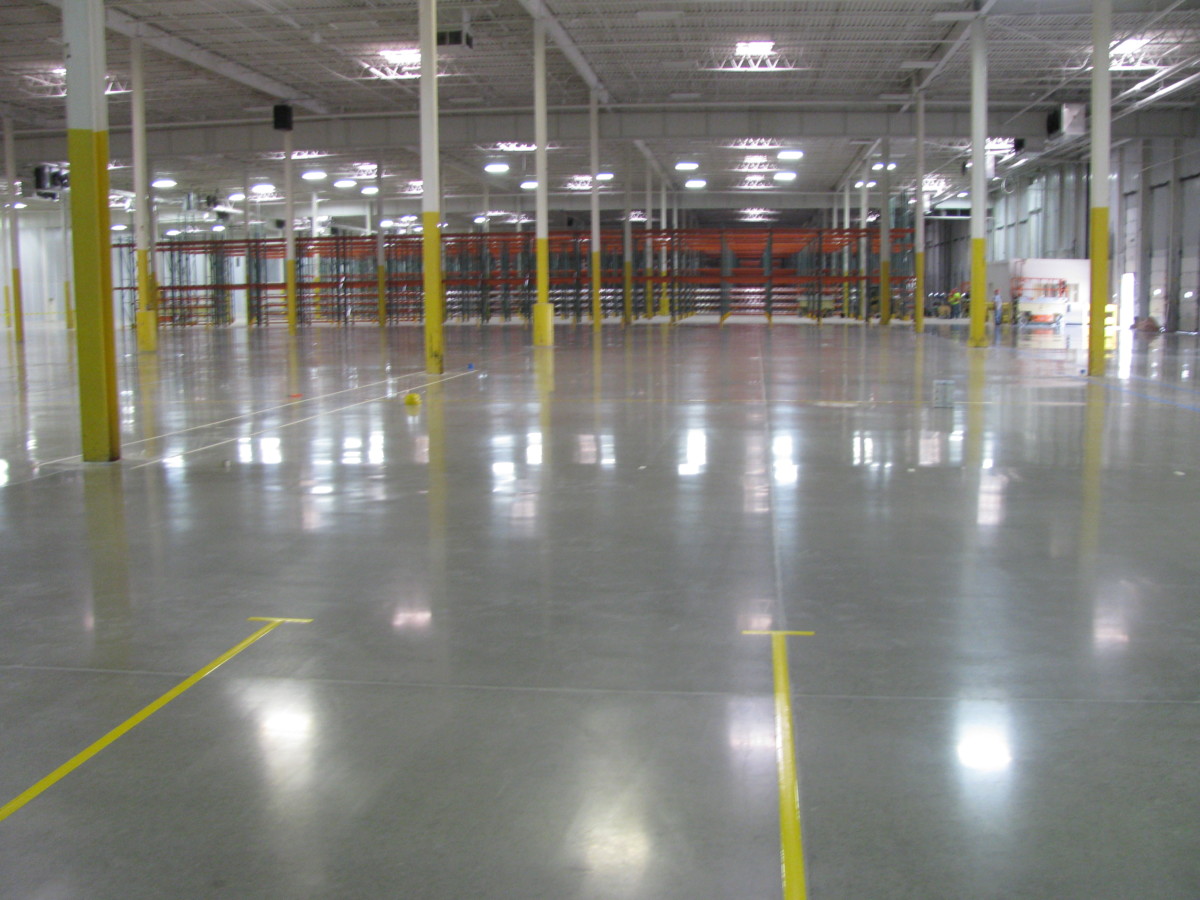
Polished concrete shines in logistics environments. It handles forklift traffic well, reflects light to improve visibility, resists tire marks, and makes sweeping and cleaning efficient. The dense surface resists abrasion from pallet jacks and heavy loads.
Retail Spaces
The aesthetic flexibility of polished concrete—with optional stains, dyes, and scoring patterns—makes it popular in retail. It photographs well, handles high foot traffic, and won’t show wear patterns like softer flooring materials.
Office Buildings
Modern office designs increasingly feature polished concrete for its clean, contemporary appearance. It’s hypoallergenic, easy to maintain, and provides excellent noise reduction compared to hard tile.
Manufacturing Light-Duty Areas
Administrative areas, break rooms, corridors, and light assembly areas in manufacturing facilities are well-suited to polished concrete. However, areas with heavy chemical exposure or extreme conditions may need resinous coating systems instead.
Educational and Institutional Facilities
Schools, universities, hospitals, and government buildings benefit from polished concrete’s durability and low maintenance. No waxing means custodial staff can focus on other priorities.
When Polished Concrete Isn’t the Right Choice
Polished concrete is excellent for many applications, but it’s not universal. Consider alternatives when:
- Chemical resistance is critical—Polished concrete handles many chemicals, but aggressive acids, solvents, or caustics may require epoxy or urethane cement systems
- Thermal shock is present—Hot washdowns or rapid temperature changes can damage polished surfaces
- The existing slab is poor quality—Thin, weak, or heavily damaged concrete may not polish well
- Slip resistance is paramount—High-gloss polished concrete, especially when wet, may not meet traction requirements for some environments
- Seamless or coved systems are needed—Food processing and pharmaceutical facilities often require seamless, sanitary floor-to-wall transitions that polished concrete can’t provide
A reputable contractor will evaluate your facility honestly and recommend the best system—even if that means suggesting something other than polished concrete.
Polished Concrete vs. Other Flooring Systems
Polished Concrete vs. Epoxy Coatings
Epoxy coatings sit on top of concrete; polished concrete is the concrete. Epoxy offers better chemical resistance and more color options but can peel, chip, and requires periodic recoating. Polished concrete is more durable in the long term but less customizable.
Polished Concrete vs. VCT (Vinyl Composition Tile)
VCT has lower initial costs but requires constant maintenance: waxing, stripping, and eventual replacement. Over 20 years, polished concrete typically costs less when maintenance is factored in—and looks better throughout.
Polished Concrete vs. Stained Concrete
Staining adds color but doesn’t provide the surface hardness or reflectivity of polishing. Many projects combine staining with polishing for decorative colored floors that still perform.
What to Look for in a Polished Concrete Contractor
Quality varies enormously in the polished concrete industry. When evaluating contractors:
- Experience matters—Look for contractors with demonstrated history in your project type
- Equipment ownership—Quality contractors own their grinding and polishing equipment rather than renting
- Specification clarity—Proposals should specify grit sequence, densifier type, exposure level, and finish gloss
- References—Ask for projects similar to yours and follow up with those clients
- Realistic timelines—Proper polished concrete takes time. Beware contractors promising unusually fast completion
Maintenance Best Practices
Polished concrete is low-maintenance, not no-maintenance. Follow these practices to protect your investment:
- Daily dust mopping—Removes abrasive particles that can scratch the surface over time
- Weekly wet mopping—Use a neutral pH cleaner (avoid acidic or alkaline cleaners)
- Prompt spill cleanup—While polished concrete resists most stains, some materials (acids, oils) can penetrate if left too long
- Mat placement—Entry mats capture grit before it reaches the polished surface
- Periodic burnishing—High-traffic areas may benefit from occasional burnishing to maintain shine
Ready to Explore Polished Concrete?
With over 35 years of experience in industrial flooring—including extensive polished concrete work in warehouses, distribution centers, retail spaces, and commercial facilities—Summit Industrial Flooring can help you determine if polished concrete is right for your project.
We’ll evaluate your existing slab, understand your operational requirements, and provide honest recommendations. If polished concrete isn’t the best fit, we’ll tell you—and suggest what is.
Contact Summit Industrial Flooring to discuss your polished concrete project. We serve Ohio, South Carolina, North Carolina, and surrounding regions.
Key Points
Why has polished concrete shifted from an industrial afterthought to one of the most specified commercial and industrial flooring systems?
- Technology advancement in diamond tooling and chemical densifiers transformed polished concrete from a basic grinding operation into a sophisticated multi-step system capable of producing finishes that rival any flooring material aesthetically while delivering performance characteristics that coatings cannot match over the long term.
- The maintenance cost advantage became quantifiable as facilities that switched from VCT and wax-based maintenance programs to polished concrete documented the 30 to 50 percent maintenance cost reductions that the elimination of waxing, stripping, and replacement cycles produced. Once these numbers circulated through facility management communities, the adoption curve accelerated.
- Sustainability specification pressure from LEED and comparable programs made polished concrete’s inherent sustainability advantages — using the existing slab, eliminating coating manufacture and disposal cycles, and reducing cleaning chemical consumption — competitive advantages in project specifications where environmental performance affects project scoring and client commitments.
- The lighting efficiency benefit became a facility operational argument beyond aesthetics — facilities documenting 20 to 30 percent reductions in lighting requirements after high-gloss polished concrete installation converted a flooring decision into an energy cost discussion that had no equivalent in VCT or coating alternatives.
- The durability argument shifted from theoretical to demonstrated as the first generation of large-scale polished concrete installations in warehouses and distribution centers aged and continued performing — proving that the system’s longevity claims were not marketing language but field-verified outcomes across high-demand commercial and industrial applications.
- Summit Industrial Flooring’s three-plus decades of concrete polishing experience spans the full arc of this technology evolution — from early grinding operations to the sophisticated multi-step systems that deliver current performance standards — providing clients with the accumulated knowledge of what the technology can and cannot accomplish across the full range of commercial and industrial applications it now serves.
How does the densification step transform the concrete surface and why is it the chemical foundation of polished concrete performance?
- Concrete’s natural porosity is the performance limitation that densification addresses — ordinary concrete absorbs liquids, harbors contaminants in its pores, generates calcium hydroxide dust at the surface, and provides insufficient hardness for the reflective polishing that the subsequent steps require. Densification eliminates these limitations through chemistry rather than coating.
- Lithium, sodium, and potassium silicate densifiers react with the calcium hydroxide that concrete releases as a byproduct of the cement hydration process — producing calcium silicate hydrate, the same compound that gives cement paste its strength. This reaction fills the concrete’s pores with material that is harder and more chemically stable than the original concrete matrix.
- The 40 percent surface hardness increase that densification produces is not a coating effect but a chemical transformation of the concrete itself — the densified surface is genuinely harder than the undensified concrete beneath it, which is why polished concrete’s surface performs durably rather than simply reflecting wear onto a softer substrate.
- Dust reduction through pore sealing is the operational benefit in warehouse and distribution environments where concrete dust — generated by untreated concrete under forklift and pallet jack traffic — creates product contamination risk, housekeeping burden, and air quality concerns. Densification eliminates the dust source rather than managing its consequences.
- Stain resistance improvement from densification reduces the porosity through which liquids penetrate the concrete and cause permanent staining — the densified surface provides the additional response time for spill cleanup that untreated concrete does not offer. This is the mechanism behind polished concrete’s practical stain resistance, distinct from the chemical resistance of coating systems.
- The quality of densifier application — product selection appropriate to the concrete’s age and composition, correct application timing relative to grinding stage, and appropriate wet application technique — determines whether the chemical reaction achieves full penetration depth or produces a shallow surface treatment that wears through faster than the specification assumes. Summit Industrial Flooring’s densification protocol reflects the accumulated knowledge of what produces lasting results across the concrete types and conditions encountered across three decades of installations.
What makes warehouses and distribution centers the ideal application environment for polished concrete and what performance characteristics drive adoption in logistics facilities?
- Forklift and pallet jack traffic resistance is the primary durability requirement in logistics environments and the performance category where polished concrete’s hardened, dense surface most directly outperforms alternatives. The repeated concentrated loads of loaded forklifts, the lateral stress of turning under load, and the abrasion of hard rubber tires are all conditions that polished concrete handles without the delamination, peeling, and coating failure that the same traffic produces in coated floor systems.
- Light reflectivity improvement in warehouse environments is an operational efficiency argument with measurable ROI — high-bay warehouses with polished concrete floors require fewer lighting fixtures or lower lumen output to achieve equivalent foot-candle levels at the floor, because the reflective surface bounces light back into the space rather than absorbing it. Summit Industrial Flooring has documented 20 to 30 percent lighting requirement reductions in distribution center installations.
- Tire mark resistance is a specific logistics facility maintenance concern that polished concrete addresses better than most alternatives — the dense, smooth surface repels the rubber residue that forklift tires deposit on less-refined concrete and on coating surfaces, reducing the frequency and labor intensity of floor cleaning to maintain appearance standards.
- Sweep-ability and cleanability in large open floor areas is a practical maintenance efficiency consideration in distribution centers where floor area is measured in hundreds of thousands of square feet and cleaning equipment operates continuously across operational shifts. Polished concrete’s smooth, hard surface cleans faster per square foot than coated, textured, or VCT surfaces — a maintenance efficiency advantage that compounds into significant labor cost savings at logistics scale.
- No coating downtime for reapplication across the floor’s service life is a logistics facility operational advantage with direct revenue implications — coating systems require facility or zone shutdown for recoating events that polished concrete does not. In 24-hour distribution operations, this elimination of downtime events is a specification advantage beyond the initial cost comparison.
- Summit Industrial Flooring’s warehouse and distribution center polished concrete installations across Ohio, South Carolina, and North Carolina include facilities operating at the full range of logistics intensity — from regional distribution centers to automotive component facilities — providing the reference base that logistics facility managers can evaluate against their specific operational requirements before specification commitment.
How should facility managers evaluate polished concrete contractor qualifications and what specification elements determine whether the result meets expectations?
- Equipment ownership is the foundational contractor qualification for polished concrete — the grinding and polishing equipment that produces quality results is specialized, expensive, and operator-expertise-dependent. Contractors who rent equipment are managing rental cost pressure that incentivizes compressed project timelines that compromise result quality. Summit Industrial Flooring owns its grinding and polishing equipment across all three locations.
- Specification clarity in the proposal is itself a contractor qualification indicator — a contractor who can specify the exact grit sequence, densifier product and chemistry, exposure level, and final finish grit in writing has the technical knowledge to execute the work. A contractor who describes the result in aesthetic terms without specifying the process that produces it is describing an outcome they cannot reliably deliver.
- Project type experience verification — references from facilities comparable to the project being bid in terms of floor area, traffic intensity, concrete condition, and desired exposure level — distinguishes contractors whose polished concrete history supports the current project from those whose experience is concentrated in different application types with different technical demands.
- Realistic project timeline commitment is a quality signal — the grit sequence required to produce quality polished concrete takes the time it takes, and contractors who quote unusually compressed timelines are either compressing the grit sequence or skipping steps that produce the visual and performance quality that the specification requires. Beware of timelines that seem incompatibly fast for the specified floor area and exposure level.
- Honest application evaluation — willingness to assess the existing slab’s suitability for polishing and to recommend alternatives when the slab condition, chemical exposure profile, or operational requirements make polished concrete an inappropriate specification — is the contractor behavior that protects facility managers from investing in a system that cannot deliver the performance their facility actually requires.
- Summit Industrial Flooring’s evaluation process for polished concrete projects begins with slab assessment that determines aggregate composition, concrete quality, moisture conditions, and existing coating or contamination presence — producing a specification recommendation that is grounded in the actual slab characteristics rather than in a default assumption that any concrete slab is a suitable polished concrete candidate.
What maintenance program produces the best long-term performance from polished concrete and what practices cause the most preventable surface damage?
- Daily dust mopping is the highest-impact routine maintenance action for polished concrete — the abrasive particulate that accumulates on the floor surface from foot and equipment traffic causes micro-scratching of the polished surface with every subsequent pass if not removed. This abrasion is the primary mechanism for polished concrete surface degradation over time, and its prevention through consistent dust mopping extends the interval before burnishing or re-polishing is required.
- Neutral pH cleaner selection for wet mopping is a maintenance requirement rather than a preference — acidic cleaners etch the densified concrete surface and reverse the chemical hardening that densification achieved, while alkaline cleaners can degrade the surface over repeated use. The neutral pH requirement eliminates the acidic and alkaline cleaning products that are appropriate for other floor types but damaging to polished concrete’s chemically sensitive surface.
- Entry mat placement captures abrasive grit before it reaches the polished surface — the same entry mat principle that protects LVP and hardwood flooring from tracked-in abrasives applies equally to polished concrete, where grit underfoot produces the same progressive micro-scratching that daily dust mopping is designed to remove. Mats at every exterior entry point reduce the dust mopping frequency required to maintain surface quality.
- Prompt spill cleanup is a stain prevention measure rather than a stain removal measure for polished concrete — densification improves stain resistance by reducing porosity, but it does not make the surface impervious to penetration by acidic materials, oils, and concentrated chemicals if they are allowed to sit and react with the concrete surface. The window between a spill occurring and it penetrating the densified surface is the maintenance variable that prompt response manages.
- Periodic burnishing in high-traffic areas restores the reflective quality that normal wear gradually reduces in the heaviest traffic paths — burnishing is a maintenance tool that extends the service life between more intensive re-polishing events by maintaining the surface’s light-reflective properties in the zones where wear concentrates fastest.
- The most preventable sources of polished concrete surface damage are abrasive dragging of heavy equipment without protective measures, acidic cleaning product use, and delayed spill response — all conditions within the facility manager’s direct control through protocol rather than capital investment. Summit Industrial Flooring provides maintenance protocol guidance as a standard component of polished concrete project completion, ensuring that the maintenance program matches the system’s specific requirements from day one of occupancy.
How does Summit Industrial Flooring’s 35-year concrete polishing experience benefit clients across different facility types and project conditions?
- Three decades of concrete polishing across warehouses, distribution centers, retail spaces, manufacturing facilities, and institutional buildings produces accumulated knowledge about how different concrete compositions, slab ages, and aggregate types respond to progressive diamond tooling — knowledge that determines specification accuracy before a single diamond touches the floor.
- The technology evolution that Summit Industrial Flooring has participated in — from early grinding operations to the sophisticated multi-step systems with chemical densification, resin-bonded polishing tools, and optional guard systems that current installations employ — means the company’s recommendations reflect the full capability range of current technology rather than the practices of an earlier generation of equipment and chemistry.
- Honest limitation identification as a standard part of project evaluation protects clients from the cost of specifying polished concrete for applications where the slab condition, chemical exposure, or operational requirements make it an incorrect choice. A contractor who recommends alternative systems when polished concrete is not appropriate demonstrates the technical integrity that protects client investment rather than the sales orientation that maximizes project revenue regardless of fit.
- Multi-state service across Ohio, South Carolina, and North Carolina means Summit’s polished concrete experience encompasses the range of regional climate conditions, concrete composition variations, and facility type distributions that single-state contractors address in a narrower context. This breadth produces better specification decisions for clients whose facilities present conditions outside the narrow range that limited geographic experience has encountered.
- Equipment ownership across the full polishing capability range — grinding, polishing, and burnishing equipment at all three locations — means project scheduling is driven by project requirements rather than equipment availability and rental cost management. The quality of the polishing grit sequence is not compressed by rental economics because the equipment belongs to Summit rather than to a rental house billing by the day.
- Contact Summit Industrial Flooring at sumind.com/contact-us for polished concrete project evaluation in Ohio, South Carolina, and North Carolina — including slab assessment, exposure level consultation, specification development, and honest recommendation of whether polished concrete or an alternative system is the correct choice for the specific facility, slab, and operational conditions the project presents.
Thank you for this comprehensive guide! I learned so much about the benefits of polished concrete flooring and the detailed process involved. The applications you covered are really inspiring—I’m considering this for my own home renovation now. Great job!
This guide was incredibly informative! I never realized how many benefits polished concrete flooring offers. The step-by-step process you outlined makes it seem manageable for anyone considering it for their home or business. Thanks for shedding light on such a versatile flooring option!
This guide is incredibly informative! I had no idea that polished concrete could be so versatile in both residential and commercial spaces. The section on maintenance tips was particularly helpful. I’m considering this for my own home now!
This guide was incredibly informative! I had no idea how many benefits polished concrete flooring offered, especially in terms of maintenance and durability. The step-by-step process you outlined made it feel achievable. I’m definitely considering this for my upcoming renovation! Thank you for sharing such valuable insights!