
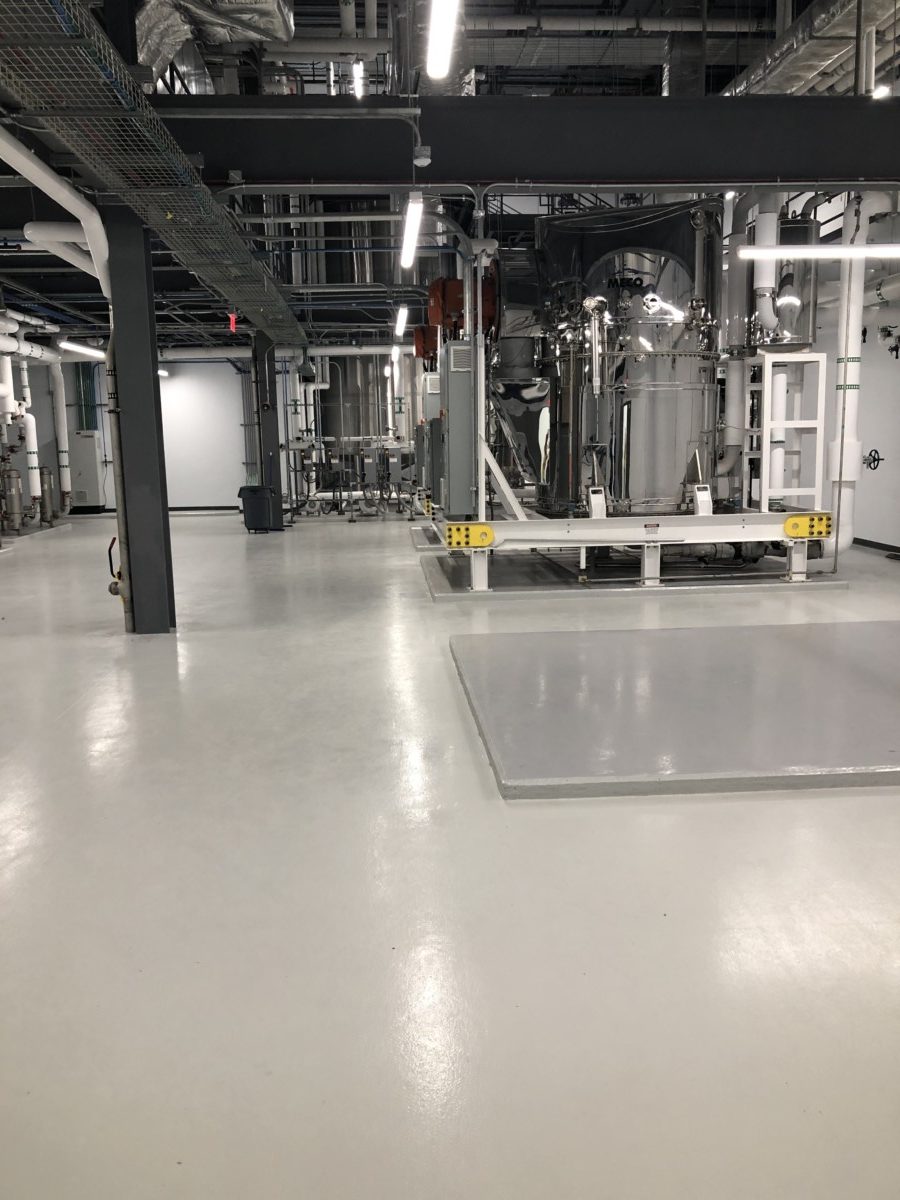
Post Summary
What are the FDA’s core flooring requirements for food processing facilities under cGMP regulations?
The FDA’s Current Good Manufacturing Practice regulations under 21 CFR Part 117 require food facility floors to be smooth, hard, seamless, and free from cracks, crevices, or open joints that could harbor bacteria. Floors must withstand daily cleaning with hot water, detergents, and chemical sanitizers without degrading. Production areas must slope toward drains at 1/8 to 1/4 inch per foot to prevent standing water. Where floors meet walls, a coved transition of at least 4 inches high is required to eliminate the 90-degree corner where bacteria accumulate — and that cove base must be integrally bonded to both surfaces using the same flooring material.
How do USDA requirements for meat, poultry, and egg facilities differ from FDA baseline standards?
USDA Food Safety and Inspection Service requirements are stricter than FDA baseline standards across several dimensions. They require impervious flooring that will not absorb moisture or contaminants, light-colored surfaces to make contamination visible during inspections, specific slope requirements in processing and slaughter areas, anti-slip surfaces in wet processing zones with documented coefficient of friction testing, and thermal shock resistance in areas subject to extreme temperature changes from hot washdowns or steam cleaning. USDA inspectors conduct daily pre-operational inspections — a failed inspection stops production until the deficiency is corrected.
Which flooring systems actually meet food processing compliance requirements and which ones fail?
Urethane cement mortar is the gold standard for most food and beverage facilities, offering thermal shock resistance from -40°F to 250°F, exceptional chemical resistance, USDA acceptance, and the ability to install over damp concrete. Epoxy flooring suits dry processing areas and packaging zones where thermal shock is not a concern. MMA systems are appropriate for facilities that cannot tolerate extended downtime due to their one-hour cure time. Flooring systems that consistently fail food processing requirements include painted concrete, thin-film epoxy, tile with grout lines, unsealed concrete, and residential garage coatings — all of which create contamination risks, compliance failures, or both.
What are the most common compliance failures that cause food processing facilities to fail inspections?
The five most frequent failures are inadequate surface preparation producing floors that delaminate and create bacterial harboring crevices; wrong system specification — particularly standard epoxy installed in wet processing areas where steam cleaning causes thermal shock delamination; missing or inadequate cove bases at wall transitions; poor drainage design leaving standing water after washdowns; and incompatible patch repairs that create seams at the repair boundary. Each of these failures is preventable through correct specification and experienced installation, and each will draw immediate attention from FDA and USDA inspectors.
How should food processing facility managers plan a flooring project to ensure compliance and minimize production disruption?
Effective planning starts with documenting the specific operating conditions the floor will face — temperature extremes, chemical exposure types, traffic patterns, impact risks, and moisture levels — before any system is specified. Flooring contractors should be involved during design for new construction so that concrete specifications and drainage requirements are coordinated before the slab is poured. For renovation projects, phased installation around production schedules reduces downtime. Written documentation of the installed system — including technical data sheets confirming FDA and USDA compliance, chemical resistance ratings, and thermal performance specifications — should be required from the contractor before project completion.
When it comes to food and beverage facilities, flooring isn’t just about aesthetics or durability—it’s about safety, compliance, and protecting your operation from costly shutdowns. With over 35 years of experience installing industrial flooring systems, we’ve seen firsthand how the right floor can make or break a food processing operation.
Whether you’re building a new facility, renovating an existing plant, or facing an inspection, understanding FDA and USDA flooring requirements is essential. This guide breaks down everything you need to know about choosing compliant flooring that keeps your facility operational and your products safe.
Why Food Processing Flooring Requirements Exist
Food safety regulations exist for one simple reason: contaminated products can sicken or kill consumers. Flooring plays a critical role in maintaining sanitary conditions because:
- Floors are the largest horizontal surface in any facility, collecting spills, debris, and potential contaminants
- Porous or damaged floors harbor bacteria, including Listeria, Salmonella, and E. coli
- Improper drainage creates standing water, a breeding ground for pathogens
- Chemical resistance matters when cleaning with harsh sanitizers daily
The FDA’s Food Safety Modernization Act (FSMA) puts the burden on food manufacturers to prevent contamination—not just react to it. Your floor is your first line of defense.
FDA Flooring Requirements for Food Facilities
The FDA’s Current Good Manufacturing Practice (cGMP) regulations (21 CFR Part 117) establish clear standards for food facility construction, including floors:
Seamless and Non-Porous
Floors must be smooth, hard, and free from cracks, crevices, or open joints that could harbor bacteria. Tile floors with grout lines, painted concrete, and worn epoxy all fail this requirement. The solution? Seamless resinous flooring systems that create a monolithic, impermeable surface.
Easy to Clean and Sanitize
Floors must withstand daily cleaning with hot water, detergents, and chemical sanitizers without degrading. This means chemical-resistant systems like urethane cement or specialized food-grade epoxy coatings.
Properly Sloped for Drainage
Production areas must slope toward drains (typically 1/8″ to 1/4″ per foot) to prevent standing water. This requires careful planning during installation—and often concrete resurfacing if existing slopes are inadequate.
Coved Bases
Where floors meet walls, a coved (curved) transition is required to eliminate the 90-degree corner where bacteria accumulate. Integral cove bases should be at least 4″ high and seamlessly bonded to both the floor and wall.
USDA Requirements for Meat, Poultry, and Egg Facilities
If your facility handles meat, poultry, or egg products, you’re subject to USDA Food Safety and Inspection Service (FSIS) oversight—which imposes even stricter standards:
- Impervious flooring that won’t absorb moisture or contaminants
- Light-colored surfaces to make contamination visible during inspections
- Specific slope requirements in processing and slaughter areas
- Anti-slip surfaces in wet processing zones (with documented coefficient of friction)
- Thermal shock resistance in areas with extreme temperature changes (hot washdowns, etc.)
USDA inspectors conduct daily pre-operational inspections. A floor that looks fine to you might fail their standards—and a failed inspection means production stops until the issue is corrected.
Flooring Systems That Meet Food Industry Standards
Not all “industrial flooring” meets food processing requirements. Here’s what actually works:
Urethane Cement Mortar (Best for Most Food Facilities)
Urethane cement flooring is the gold standard for food and beverage facilities. This system offers:
- Thermal shock resistance from -40°F to 250°F+ (withstands steam cleaning and hot product spills)
- Exceptional chemical resistance to organic acids, fats, sugars, and cleaning chemicals
- 4-6mm thickness that survives heavy impact and continuous traffic
- USDA accepted and FDA compliant
- Anti-microbial options for added protection
Urethane cement can also be installed over damp concrete—a significant advantage in facilities where shutting down for extended dry times isn’t feasible.
Epoxy Flooring (For Dry Processing and Packaging)
Epoxy flooring systems work well in dry processing areas, warehouses, and packaging zones where thermal shock and heavy washdowns aren’t concerns. Benefits include:
- Seamless, non-porous surface that meets FDA requirements
- Chemical resistance to common cleaning agents
- Customizable aesthetics including color-coding for different zones
- Cost-effective compared to urethane cement
However, standard epoxy fails under thermal shock—hot water on a cold floor will cause delamination. It’s also more susceptible to damage from organic acids (think citric acid in juice facilities).
MMA (Methyl Methacrylate) Systems
MMA flooring cures in as little as one hour, making it ideal for facilities that can’t afford extended downtime. It offers good chemical resistance and can be installed in cold temperatures. The tradeoff? Strong odor during installation that requires ventilation.
What DOESN’T Work in Food Processing
- Painted concrete—wears quickly, creates dust, harbors bacteria in worn areas
- Thin-film epoxy—insufficient thickness for industrial demands
- Tile with grout—grout lines are contamination highways
- Unsealed concrete—porous, stains, and deteriorates under chemical exposure
- Residential garage coatings—completely inadequate for food facility demands
Common Compliance Failures (And How to Avoid Them)
After three decades of working with food and beverage facilities across Ohio, South Carolina, and North Carolina, we’ve seen the same mistakes repeatedly:
1. Inadequate Surface Preparation
The most common cause of flooring failure in any industry—but especially critical in food processing. Floors installed over contaminated, poorly profiled, or moisture-compromised concrete will delaminate, creating crevices that harbor bacteria. Proper surface preparation using shot blasting or diamond grinding is non-negotiable.
2. Wrong System for the Environment
We’ve seen facilities install standard epoxy in wet processing areas—then face complete floor failure within months when daily steam cleaning causes thermal shock delamination. Match the flooring system to your actual operating conditions.
3. Missing or Inadequate Cove Bases
Inspectors look for this immediately. A beautiful floor with square wall transitions will fail. Cove bases must be integral (same material as the floor) and properly sealed at the top.
4. Poor Drainage Design
Standing water after washdowns is a red flag. If your existing concrete isn’t properly sloped, it needs to be corrected before the flooring system is installed—either through concrete overlay or removal and re-pouring.
5. Cutting Corners on Repairs
Patching damaged areas with incompatible materials creates seams where bacteria accumulate. Repairs should use the same system as the original floor and be made seamlessly.
Planning Your Food Facility Flooring Project
Success starts long before installation. Here’s how to approach your project:
Assess Your Operating Conditions
Document the specific demands your floor will face:
- Temperature extremes (cold storage, hot processing, steam cleaning)
- Chemical exposure (specific sanitizers, product types)
- Traffic patterns (foot traffic, forklifts, pallet jacks)
- Impact risks (dropped equipment, heavy loads)
- Moisture exposure (wet processing vs. dry)
Involve Your Flooring Contractor Early
For new construction, bring in your flooring contractor during design. Concrete specs (thickness, reinforcement, cure time) and drainage requirements need to be coordinated. Trying to fix problems after the slab is poured is expensive.
Plan for Downtime
Resinous flooring systems require clean, properly prepared surfaces and specific cure times. Work with your contractor to phase the project around production schedules. Some systems (like MMA) cure faster but have tradeoffs—discuss options.
Get It in Writing
Require documentation of the specific system being installed, including technical data sheets showing FDA/USDA compliance, chemical resistance ratings, and thermal performance. If a contractor can’t provide this, find one who can.
Why Experience Matters in Food Facility Flooring
Installing flooring in a food processing facility isn’t the same as coating a warehouse floor. It requires:
- Knowledge of regulations—understanding what inspectors look for
- Material expertise—matching systems to specific operating conditions
- Installation precision—especially for slopes, drains, and cove bases
- Quality control processes—documenting thickness, adhesion, and cure
At Summit Industrial Flooring, we’ve spent 35 years installing floors in facilities that demand compliance—from pharmaceutical clean rooms to food processing plants. We own our equipment (shot blasters, grinders, mixers), employ our own crews (no subcontractors), and work with all major resinous flooring manufacturers to recommend the right system for your specific needs.
Ready to Upgrade Your Food Facility Flooring?
Whether you’re facing an upcoming inspection, planning a new facility, or dealing with a floor that’s failing, we’re here to help. Our team serves food and beverage facilities across Ohio, North Carolina, and South Carolina—from small bakeries to large-scale processing plants.
Contact Summit Industrial Flooring for a consultation. We’ll assess your specific requirements, recommend the right system, and deliver a floor that keeps your facility compliant and operational for years to come.
Key Points
Why does food processing flooring carry compliance and safety implications that other industrial flooring categories do not?
- Floors are the largest horizontal surface in any food processing facility’ and the primary collection point for spills, debris, product residue, and potential biological contaminants. Their condition directly affects the microbiological environment the food product is produced in.
- Porous, cracked, or damaged floors harbor Listeria, Salmonella, E. coli, and other pathogens’ in ways that standard industrial cleaning cannot reach. The bacteria colonize within the floor structure itself — not just on the surface — and become a persistent contamination source that cleaning protocols cannot eliminate.
- Improper drainage creates standing water’ that provides the moisture and nutrients pathogens require to proliferate. A floor that does not drain completely after washdown is an active food safety liability between production runs.
- The FDA’s Food Safety Modernization Act shifts the compliance burden from reaction to prevention’. FSMA requires food manufacturers to proactively prevent contamination conditions rather than simply respond to contamination events after they occur — making the floor’s design and condition a regulatory obligation, not just an operational preference.
- USDA daily pre-operational inspections in meat, poultry, and egg facilities mean flooring deficiencies stop production immediately’ rather than being addressed during a scheduled audit cycle. The operational cost of a production halt triggered by a flooring deficiency can exceed the entire cost of correct flooring installation.
- Chemical resistance is a compliance requirement, not just a durability consideration’. The cleaning chemicals used in food processing — organic acids, caustic cleaners, sanitizers, and hot water at pressure — degrade flooring systems that are not specifically formulated for food facility environments, creating the very contamination harboring surfaces the cleaning is intended to prevent.
What do FDA cGMP regulations specifically require from food facility flooring and what does each requirement mean in practice?
- Smooth, hard, seamless, and crack-free surfaces are the foundational FDA requirement’ under 21 CFR Part 117. Every surface irregularity — grout line, crack, worn coating edge, open joint — is a location where food residue accumulates and bacteria colonize beyond the reach of cleaning. The seamless requirement eliminates these locations by design.
- Tile floors with grout lines fail this requirement categorically’, regardless of tile material quality or cleaning frequency. Grout is porous, absorbs organic material, and provides an ideal environment for bacterial growth that cannot be sanitized out once established. Tile is not a compliant flooring option for food contact areas.
- Chemical resistance to daily cleaning agents is an operational requirement built into the FDA standard’ because a floor that degrades under cleaning chemicals becomes non-compliant as a result of the cleaning process itself — creating a compliance cycle that only correct initial system specification can break.
- Slope toward drains at 1/8 to 1/4 inch per foot is a drainage standard’ that existing concrete frequently does not meet, requiring either concrete overlay to build correct slope into the substrate before flooring installation or, in more severe cases, removal and re-pouring of the slab. Installing a compliant flooring system over improperly sloped concrete produces a compliant surface that still fails the drainage requirement.
- Integral coved bases of at least 4 inches height at all wall-floor transitions’ eliminate the 90-degree corner that is one of the highest-risk contamination accumulation points in any food facility. The cove must be the same material as the floor — not a separate insert or sealant bead — and must be seamlessly bonded to both surfaces to eliminate any transition seam.
- Documentation of compliance is as important as the floor’s physical condition’. Technical data sheets demonstrating the installed system’s FDA compliance, chemical resistance ratings, and thermal performance specifications provide the evidence base that supports compliance claims during inspections — and that a qualified contractor must be able to provide.
What makes urethane cement mortar the preferred flooring system for most food and beverage processing environments?
- Thermal shock resistance from -40°F to 250°F and above’ is urethane cement’s most critical performance characteristic for food processing applications. Steam cleaning, hot product spills, and transitions between cold storage and ambient processing areas all impose thermal shock cycles that standard epoxy systems cannot survive — urethane cement handles these cycles without delamination or cracking.
- Exceptional chemical resistance to organic acids, fats, sugars, and the full range of food processing sanitizers’ means the system maintains its seamless, non-porous surface integrity under the cleaning regimens that food facilities run daily. This is not a generic chemical resistance claim — it is specific performance against the substances food processing floors actually encounter.
- Four to six millimeter installation thickness provides impact resistance’ adequate for the dropped equipment, heavy foot traffic, and pallet jack and forklift operations that food processing floors sustain continuously across multiple shifts.
- USDA acceptance and FDA compliance make urethane cement the lowest-risk specification’ for facilities subject to regulatory inspection. System specification that deviates from accepted standards requires justification; urethane cement specification does not.
- Installation capability over damp concrete’ removes a significant project constraint that other systems impose. Food processing facilities frequently cannot achieve the extended concrete drying periods that standard epoxy requires — urethane cement’s tolerance for residual moisture allows installation to proceed on realistic facility schedules.
- Anti-microbial additive options provide an additional defense layer’ for the highest-risk processing environments, incorporating chemistry that inhibits bacterial colonization within the surface itself rather than relying entirely on cleaning protocols.
When is standard epoxy appropriate in food facilities and what conditions make it an incorrect specification?
- Epoxy flooring is appropriate in dry processing areas, packaging zones, warehouses, and other spaces’ where thermal shock is not a condition — where the floor will not be subjected to steam cleaning, hot water washdowns, or significant temperature transitions during normal operations.
- Epoxy’s seamless, non-porous surface meets FDA requirements for smoothness and cleanability’ in these lower-demand environments at a cost point significantly below urethane cement, making it a legitimate and appropriate specification where its performance limitations do not apply.
- Standard epoxy fails under thermal shock — definitively and predictably’. Hot water on a cold epoxy surface, or steam cleaning of any kind, causes differential thermal expansion that breaks the coating’s bond to the substrate. The delamination this produces creates exactly the bacterial harboring crevices that food processing regulations exist to prevent.
- Organic acids — citric acid in juice and beverage facilities, acetic acid in food processing, lactic acid in dairy and meat environments’ — degrade standard epoxy over time, creating surface porosity and eventually substrate exposure in the areas of highest acid contact. Urethane cement’s acid resistance is specifically formulated for these exposure types.
- Color-coding epoxy for zone differentiation — different colors for production, packaging, and walkway zones’ — is a legitimate use case that urethane cement can also accommodate but at higher cost. Where zone color-coding is a requirement and the environment is dry, epoxy is a cost-effective specification.
- The most dangerous misspecification in food facility flooring is installing standard epoxy in a wet processing area’ based on its lower cost and the contractor’s familiarity with the system. This specification error produces floor failure under the facility’s normal operating conditions — not under unusual stress — within months rather than years.
What are the five most common compliance failures in food processing facility flooring and how does each one develop?
- Inadequate surface preparation is the root cause of most flooring failures’ in food processing environments as in all industrial flooring. Floors installed over contaminated, moisture-compromised, or insufficiently profiled concrete delaminate under the thermal and chemical demands of food processing — creating bacterial harboring crevices that make the floor not only structurally failed but actively non-compliant.
- Wrong system for the environment is the specification failure that produces the most operationally disruptive outcomes’. Facilities that install standard epoxy in wet processing areas face complete floor failure within months of opening — triggered by the steam cleaning that is a routine part of food facility sanitation. The floor must be removed and correctly reinstalled at a cost that exceeds the original project, plus the operational disruption of an unplanned shutdown.
- Missing or non-integral cove bases are among the first things FDA and USDA inspectors examine’ because their absence is immediately visible and represents a known bacterial accumulation point. A cove base that is a separate insert, applied sealant bead, or different material from the floor creates a seam that inspectors will cite — regardless of how well the rest of the floor is installed.
- Poor drainage design — concrete that does not slope adequately toward drains’ — produces standing water after washdowns that is a persistent food safety liability. This is a concrete issue, not a flooring issue, but it must be resolved before flooring installation or the compliant floor system still fails the drainage requirement it is installed over.
- Incompatible patch repairs create compliance failures at every repair boundary’. When a section of floor is patched with a material different from the original system, the boundary between old and new material creates a seam — a contamination point that no amount of surface cleaning eliminates. Repairs must use the same system and be performed to the same seamless standard as the original installation.
What documentation and planning practices protect food processing facility operators during inspections and flooring projects?
- Technical data sheets from the flooring system manufacturer confirming FDA and USDA compliance’ are the primary documentary evidence during regulatory inspections that the installed flooring meets applicable standards. These documents should be retained permanently as part of the facility’s compliance record — not treated as temporary project paperwork.
- Chemical resistance ratings for the specific cleaning agents the facility uses’ should be confirmed against the installed system before specification is finalized. A system with general chemical resistance claims may not be rated for the specific sanitizer concentrations a particular facility’s cleaning protocols require.
- Thermal performance specifications confirming the system’s operating temperature range’ protect against the thermal shock delamination failure that is the most common cause of early flooring failure in food processing — and provide documentation that the correct system was specified if a failure claim is made against the contractor or manufacturer.
- Installation documentation including surface preparation verification, moisture test results, and cure time records’ establishes that installation was performed to specification — protecting both the facility operator and the contractor if floor performance is questioned during a subsequent inspection or warranty claim.
- Involving the flooring contractor during facility design for new construction’ — before the concrete slab is specified and poured — ensures that concrete thickness, reinforcement, drainage slope, and cure time requirements are coordinated with the flooring system’s substrate requirements. Trying to correct concrete deficiencies after the slab exists is significantly more expensive than designing correctly from the start.
- Requiring written warranty documentation that covers both workmanship and materials’, specifies the warranty duration, and identifies the contractor’s response obligations for warranty claims protects the facility operator’s investment and establishes the accountability framework that motivates installation quality — a contractor who warranties their work has a financial interest in doing it correctly the first time.
1 comment on “FDA and USDA Flooring Requirements for Food Processing Facilities: A Complete Compliance Guide”