“How much does epoxy flooring cost?” It’s the first question every facility manager asks, and it’s the hardest one to answer with a single number. After 35 years of installing industrial flooring systems across Ohio, the Carolinas, and beyond, we’ve learned that the real answer depends on what you’re actually trying to accomplish—and what you’re trying to protect against.
This guide breaks down the factors that drive industrial epoxy flooring costs, provides realistic price ranges for different applications, and explains why the cheapest quote often costs you more in the long run.
The Short Answer: Industrial Epoxy Flooring Costs $3 to $12+ Per Square Foot Installed
That range is enormous for a reason. A simple epoxy coating over a clean, sound concrete floor is a completely different project than a full urethane cement system in a food processing plant with drainage slopes, chemical resistance requirements, and FDA compliance needs.
Here’s a more useful breakdown:
| Flooring System | Cost Per Sq Ft (Installed) | Best For |
| Epoxy Coating (2-3 mils) | $3-5 | Light industrial, warehouses, minimal traffic |
| Epoxy Floor System (10-20 mils) | $5-8 | Manufacturing, distribution, moderate traffic |
| Quartz/Flake Broadcast Epoxy | $6-9 | Showrooms, automotive, decorative needs |
| Urethane Cement | $9-14 | Food & beverage, pharma, thermal shock |
| MMA (Methyl Methacrylate) | $7-11 | Fast-cure needs, cold storage |
| Novolac Epoxy | $8-12 | Chemical processing, acid resistance |
| ESD/Static Dissipative | $8-15 | Electronics, data centers, aerospace |
These are general ranges for straightforward installations. Your project may be higher or lower depending on the factors below.
The 7 Factors That Actually Determine Your Flooring Cost
1. Concrete Condition (The Hidden Variable)
This is where most “cheap” quotes fall apart. The condition of your existing concrete floor determines 30-50% of your final cost—and it’s the factor most often glossed over in competitive bids.
Clean, sound concrete with minimal repairs needed: You’ll hit the low end of cost ranges.
Concrete with existing coatings, contamination, or damage: Add $1-3+ per square foot for remediation. Old coatings need to be removed. Oil contamination needs treatment. Cracks need repair. Spalls need patching. Moisture issues need mitigation systems.
We’ve seen projects where the “preparation” portion of the work cost more than the actual flooring system—and that preparation was the difference between a floor that lasted 15 years and one that delaminated in 18 months.
2. System Thickness and Complexity
A thin epoxy coating (2-3 mils) is essentially paint for your floor. It provides some protection and looks decent, but it won’t handle forklift traffic, chemical exposure, or heavy impact.
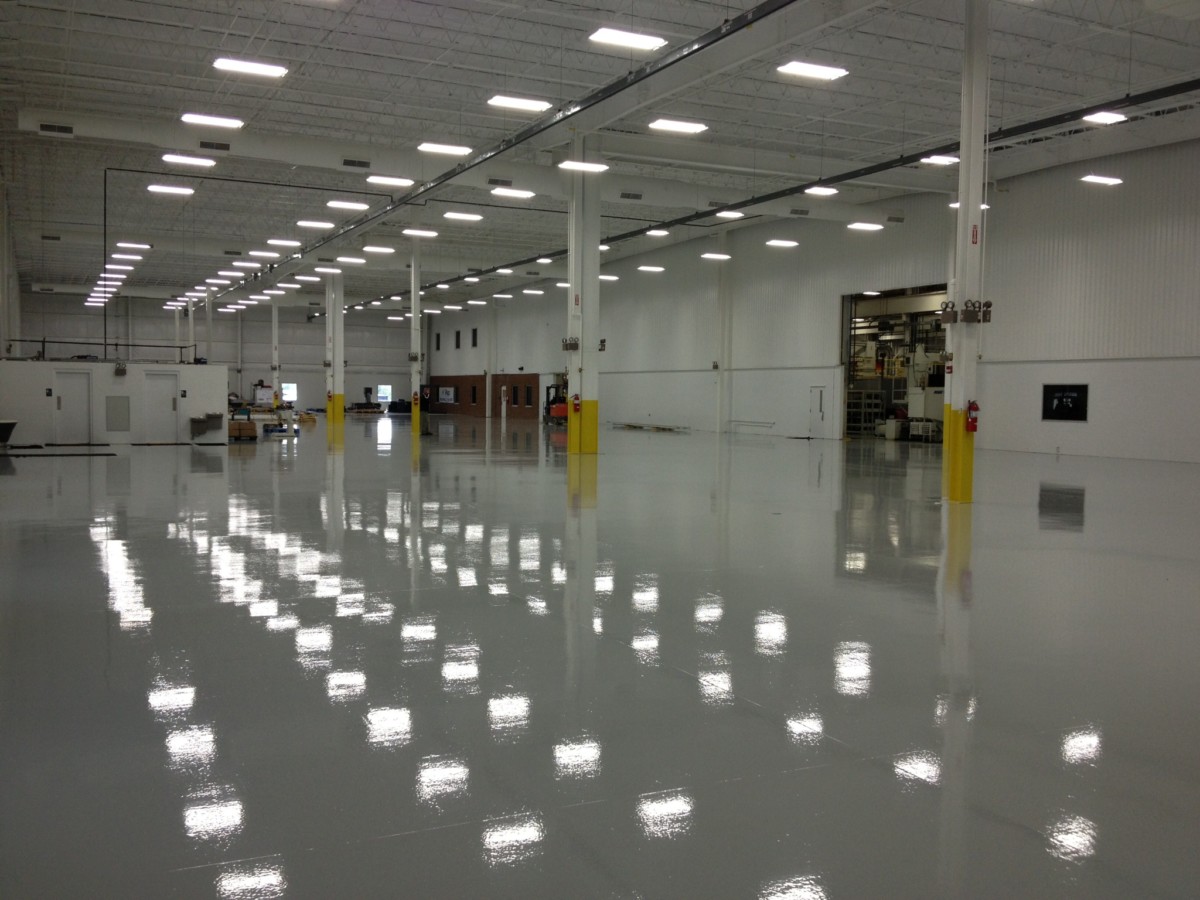
A true industrial epoxy system builds up multiple layers—primer, body coats, topcoat—to create a durable, monolithic surface that can handle real industrial abuse.
More layers = more material = higher cost. But also more durability, more protection, and a longer lifespan.
3. Chemical and Thermal Requirements
Standard epoxy handles most warehouse and light manufacturing environments. But specialized environments need specialized systems:
- Food processing: Urethane cement systems withstand thermal shock from hot wash-downs and steam cleaning
- Chemical processing: Novolac epoxy resists aggressive acids and solvents that would destroy standard epoxy
- Electronics/Data centers: ESD flooring controls static discharge that could damage sensitive equipment
- Pharmaceutical: Systems meeting FDA and cGMP requirements with seamless, sanitizable surfaces
These specialized systems cost more because the materials cost more and the installation requirements are more demanding. There’s no way to get pharmaceutical-grade performance from a warehouse-grade system.
4. Project Size
Flooring has significant fixed costs: equipment mobilization, crew travel, surface preparation setup. These costs get spread across your total square footage.
Smaller projects (under 5,000 sq ft): Higher cost per square foot because fixed costs are spread over less area.
Larger projects (20,000+ sq ft): Better economies of scale, lower cost per square foot.
This doesn’t mean small projects aren’t worth doing—just that the per-square-foot math looks different.
5. Access and Logistics
A wide-open warehouse floor is straightforward. A pharmaceutical clean room with air handling requirements, limited access times, and contamination protocols is not.
Factors that add complexity and cost:
- Night and weekend work requirements
- Active production environments needing phased installation
- Areas with restricted access or security requirements
- Floors with many penetrations, drains, or equipment anchors
- Sloped drainage requirements
6. Geographic Location
Labor costs vary by region. Material delivery costs vary by distance from suppliers. A project in rural Kentucky costs different than one in downtown Cincinnati.
Working with a contractor who has regional offices near your facility typically reduces mobilization costs and improves response time for both installation and warranty service.
7. Downtime Costs
This is the cost factor most people forget to include in their analysis. Standard epoxy systems require 24-72 hours cure time before light traffic and up to 7 days before full chemical resistance develops.
If your facility loses $10,000 per day in production, that cure time is costing you $70,000-100,000 in downtime.
Fast-cure systems like MMA (methyl methacrylate) or certain polyaspartic systems can return to service in hours instead of days. They cost more per square foot but may cost less overall when you factor in avoided downtime.
Why the Cheapest Quote Usually Isn’t
In our 35 years of industrial flooring work, we’ve replaced hundreds of floors that “failed prematurely.” Almost every one had the same story: the facility manager got three quotes, picked the cheapest one, and ended up paying twice.
Here’s what the cheap quote usually leaves out:
Inadequate Surface Preparation
Proper surface preparation requires specialized equipment—shot blasters, diamond grinders, vacuum systems—and the expertise to use them correctly. This is the most labor-intensive part of any flooring project.
Cutting corners here means the coating can’t bond properly. Within months or a few years, it starts peeling, flaking, or delaminating. Then you pay for removal of the failed system AND a proper installation.
A contractor who owns their own equipment (like we do) isn’t paying rental fees and can justify doing the job right. A contractor renting equipment has pressure to minimize machine time.
Thin System Specs
There’s always a lower-cost system that “will work” for your application. Sometimes that’s true. Often it’s not.
A good contractor will tell you when you’re overspecifying (and wasting money) AND when you’re underspecifying (and setting yourself up for premature failure). An honest conversation about what you actually need is worth more than a low bid on the wrong system.
Hidden Change Orders
Low bids often come with broad exclusions: “excludes repair of concrete defects,” “excludes removal of existing coatings,” “excludes moisture mitigation if needed.”
These exclusions become expensive change orders once the project starts. The low bid was just a way to get the job—the real price comes later.
How to Get an Accurate Quote
The more information you can provide upfront, the more accurate your quote will be:
- Total square footage of the area(s) to be coated
- Current floor condition: Bare concrete? Existing coating? Known damage or contamination?
- Environmental requirements: Chemical exposure? Temperature extremes? Cleanability requirements?
- Traffic type: Foot traffic only? Forklift? Pallet jacks? Heavy machinery?
- Access constraints: Operating hours? Phasing requirements? Clean room protocols?
- Timeline expectations: Standard schedule or expedited installation needed?
Any reputable contractor will want to see the floor in person before providing a firm price. Walk the space with them. Point out problem areas. Ask questions about what they’re seeing.
The Bottom Line on Industrial Flooring Costs
Industrial flooring is an infrastructure investment. The right system, properly installed, protects your concrete, protects your workers, supports your operations, and lasts 15-25+ years.
When evaluating quotes, look at:
- Total installed cost—not just the per-square-foot number
- What’s included in surface preparation
- System specifications and expected lifespan
- Warranty terms and the contractor’s track record honoring them
- Downtime requirements and associated production costs
The question isn’t really “how much does epoxy flooring cost?” The question is “what’s the total cost of protecting this floor over the next 15-20 years?” That calculation usually favors quality over lowest bid.
Get a Quote for Your Facility
Summit Industrial Flooring has been installing industrial floor systems since 1990. We own our own equipment, employ our own crews, and stand behind our work with a written warranty.
If you have an industrial flooring project in Ohio, North Carolina, South Carolina, or surrounding states, we’d be glad to take a look and provide a detailed proposal.
Contact us for a free consultation and estimate.
2 comments on “How Much Does Industrial Epoxy Flooring Cost? A Complete Pricing Guide for 2026”