
Post Summary
What are the five most common signs that an industrial floor needs replacement rather than repair?
Summit Industrial Flooring’s 35 years of field experience across Ohio, North Carolina, and South Carolina identify five primary warning signs. First, widespread cracking and spalling — networks of cracks spreading across the floor surface, chunks of concrete breaking away, or deep fractures penetrating beyond the coating. Second, delamination and peeling — coating lifting from the concrete substrate, bubbles forming under the surface, or hollow sounds when tapping the floor. Third, chemical damage and staining — discoloration, etching, or softening of the coating in areas of chemical exposure, indicating the current system cannot handle the facility’s actual chemical profile. Fourth, loss of slip resistance — textured aggregate worn smooth in traffic lanes, creating OSHA-reportable slip and fall hazards. Fifth, visible wear patterns and thinning — primer or bare concrete showing through in traffic lanes while color remains in low-traffic zones, indicating the topcoat has been fully exhausted.
What causes industrial floor delamination and why can it not be patched?
Delamination — where the coating lifts away from the concrete substrate — traces to three root causes in the majority of cases. Poor surface preparation during the original installation is the most common cause: the concrete was not properly profiled through shot blasting, diamond grinding, or mechanical methods that create the surface texture the coating needs to bond mechanically. Moisture vapor transmission from below the slab pushes the coating up from beneath, particularly in ground-level and below-grade installations where concrete releases moisture continuously. Contamination from oil, grease, or other substances prevented proper adhesive bond formation during installation. Delamination cannot be patched because the bond failure that caused the visible lifting will spread to the edges of any repair — the patched area simply creates a new peel point where traffic continues the failure. The floor must be removed down to sound concrete, the substrate prepared correctly, and a new system installed over a properly tested substrate.
When is recoating a viable option versus full industrial floor replacement?
The distinction between recoating and replacement depends on the extent and nature of the damage. Recoating is appropriate when the existing coating is worn but structurally sound — the topcoat has faded or lost texture in traffic lanes but the base coats and primer remain adhered to the concrete. A maintenance recoat in these situations extends system life significantly at a fraction of full replacement cost. Full replacement is warranted when cracking or spalling affects more than 10 to 15 percent of the floor area, when delamination is present in any significant extent, when the underlying concrete has sustained chemical damage, or when multiple warning signs appear simultaneously. Piecemeal repairs on a floor showing multiple failure modes typically cost nearly as much as replacement while producing a patchwork result that continues to fail — making professional assessment of the total condition the necessary first step before committing to either approach.
What are the hidden costs of delaying industrial floor replacement and how do they accumulate?
Every month of delayed replacement generates costs across multiple categories that the replacement project’s price tag does not. Repair expenses accumulate as spreading problems require increasingly extensive patchwork that provides diminishing returns. Productivity losses develop as workers and equipment navigate around damaged areas, slow down on hazardous surfaces, or lose access to sections under repair. Safety incidents from trip hazards and degraded slip resistance create OSHA liability, workers’ compensation exposure, and the human cost of workplace injuries. Failed inspections in food processing and pharmaceutical facilities can trigger production shutdowns whose cost in a single day may exceed the entire flooring project. Damage to equipment from uneven surfaces and concrete debris reduces machinery service life. Dust and contamination from deteriorating concrete create housekeeping and air quality issues that affect both product quality and employee health. A floor that costs eight to twelve dollars per square foot to replace does not become cheaper by waiting — it becomes more expensive as substrate damage accumulates beneath the surface.
What does the industrial floor replacement process involve and how long does it take before a facility can return to full operation?
Industrial floor replacement follows a defined sequence that Summit Industrial Flooring executes across its Ohio, South Carolina, and North Carolina facilities. Assessment and testing identifies the extent of damage, moisture conditions, and the root cause of failure — preventing the same mistakes from recurring in the new system. Coating removal through diamond grinding, shot blasting, or scarification exposes sound concrete for the new system. Concrete repair addresses cracks, spalled areas, and joint conditions with high-strength repair mortars. Moisture mitigation — vapor barriers or moisture-mitigating primers — is installed where testing reveals elevated vapor transmission. The new system is installed in layers according to specification, with appropriate cure time between coats. Return to service typically allows light foot traffic within 24 hours and full forklift and equipment traffic within 72 hours to 7 days depending on the specific system installed. Summit’s scheduling approach minimizes production disruption through phased installation, weekend work, and off-shift installation windows that keep operations running throughout the replacement process.
Your industrial floor takes a beating every day. Forklifts, heavy machinery, chemical spills, constant foot traffic — it’s the hardest-working surface in your facility. But even the best floor systems don’t last forever, and waiting too long to address problems can cost you far more than proactive replacement.
After 35 years of installing and maintaining industrial floors across Ohio, North Carolina, and South Carolina, we’ve seen every type of floor failure imaginable. Here are the five most common signs that your floor needs attention — and what to do when you spot them.
1. Widespread Cracking and Spalling
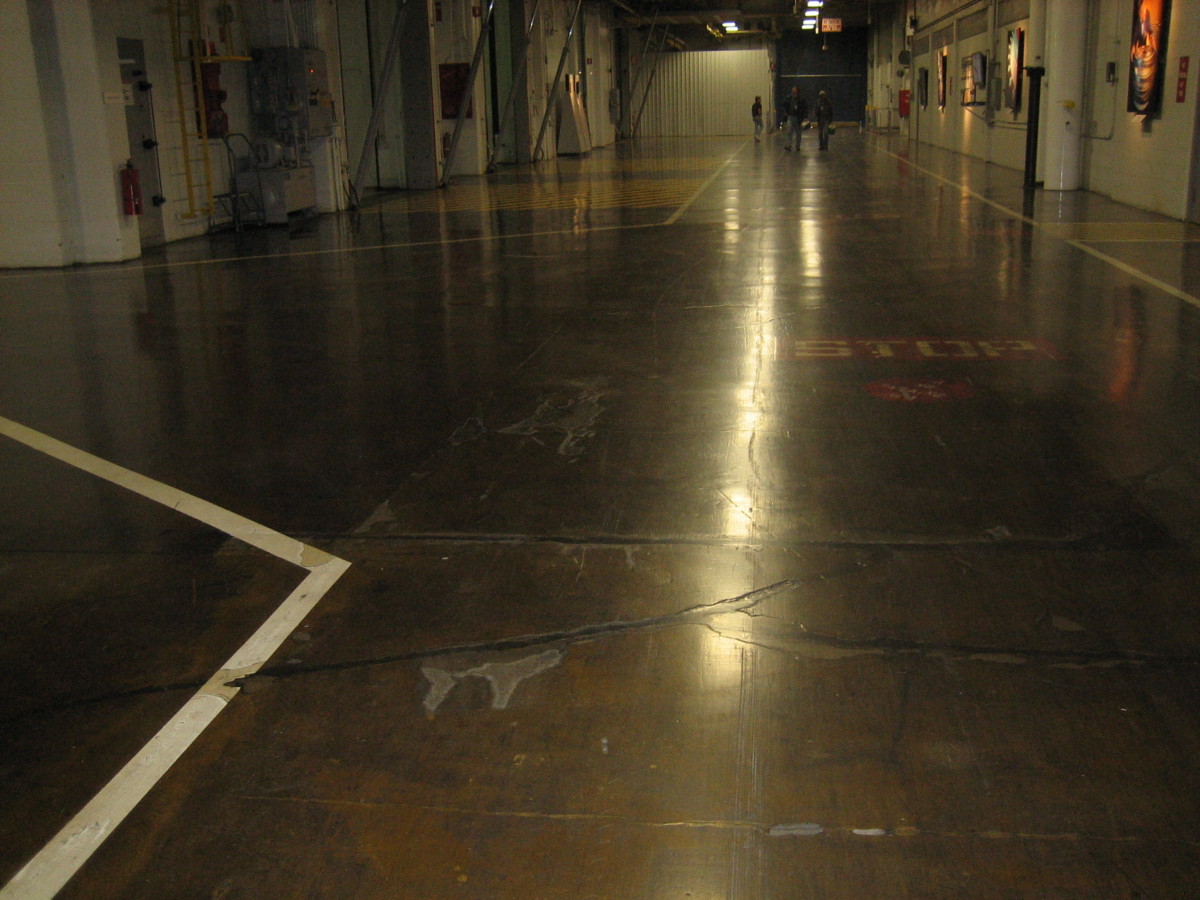
What it looks like: Networks of cracks spreading across your floor, chunks of concrete breaking away from the surface (spalling), or deep fractures that penetrate beyond the coating.
Why it happens: Concrete naturally cracks over time due to shrinkage, thermal cycling, and stress from heavy loads. When your floor coating was applied over compromised concrete — or when the substrate wasn’t properly prepared — these cracks telegraph through to the surface.
The real danger: Cracks aren’t just cosmetic. They trap dirt, harbor bacteria, allow moisture intrusion, and create trip hazards. In food processing environments, cracks can mean failed health inspections. In pharmaceutical facilities, they can compromise clean room protocols.
What to do: Isolated cracks can often be repaired with epoxy injection or routing and filling. But if more than 10-15% of your floor area shows cracking or spalling, you’re typically better off with full recoating or replacement. The repair costs add up quickly, and patched floors rarely perform as well as properly resurfaced ones.
2. Delamination and Peeling
What it looks like: Coating lifting away from the concrete substrate, bubbles under the surface, sections peeling like sunburned skin, or hollow sounds when you tap the floor.
Why it happens: Delamination almost always traces back to one of three causes:
- Poor surface preparation — The original installer didn’t properly profile the concrete (shot blasting, grinding, or acid etching to create mechanical bond)
- Moisture problems — Vapor transmission from below pushed the coating off, or moisture was trapped under the coating during installation
- Contamination — Oil, grease, or other contaminants prevented proper adhesion
The real danger: Once delamination starts, it spreads. The edges of delaminated areas create peel points where forklift traffic and foot traffic accelerate failure. What starts as a small bubble becomes a warehouse-wide problem within months.
What to do: You can’t patch delamination — the bond has failed, and that failure will spread to adjacent repaired areas. The floor needs to be removed down to sound concrete, the substrate properly prepared (and moisture tested), and a new system installed. This is not a DIY project.
3. Chemical Damage and Staining
What it looks like: Discoloration, etching, or softening of the floor coating. Chemical spills leave permanent marks. The surface texture changes in affected areas.
Why it happens: Every coating system has chemical resistance limits. Standard epoxy handles most industrial chemicals well, but battery acid, certain solvents, and strong caustics will attack it. Food processing facilities face constant assault from acids, cleaning chemicals, and high-temperature washdowns.
The real danger: Chemical damage isn’t just surface-level. Once the protective coating is compromised, the underlying concrete becomes vulnerable. Acids attack concrete aggressively, and what looked like surface staining can become structural damage.
What to do: If chemical exposure is a regular part of your operation and your current floor can’t handle it, you need a system upgrade — not just recoating. Urethane cement flooring handles most acids and can withstand thermal shock from steam cleaning. Novolac epoxies resist solvents that would destroy standard epoxy. Get your chemical exposure profile assessed before specifying a replacement system.
4. Loss of Slip Resistance
What it looks like: Workers are slipping more often. The textured broadcast that used to provide grip has worn smooth. Wet areas have become skating rinks.
Why it happens: Floor texture wears down over time, especially in high-traffic areas. Forklift tires polish the surface. Cleaning chemicals can accelerate wear. And some original installations simply didn’t include enough aggregate broadcast for the expected traffic.
The real danger: OSHA takes slip-and-fall injuries seriously. They’re one of the most common workplace injuries and can result in serious liability exposure. Beyond compliance, slip-resistant floors protect your employees — people you’ve invested in training and who keep your operation running.
What to do: If wear is localized (main traffic lanes, loading areas), you may be able to recoat just those sections with a textured topcoat. If slip resistance has degraded facility-wide, full recoating is more economical. And if you’re replacing the floor, work with your installer to specify the right aggregate size and density for your traffic patterns and cleaning protocols.
5. Visible Wear Patterns and Thinning
What it looks like: The coating looks faded or thin in traffic lanes. You can see the primer or bare concrete showing through. Color has worn away in work areas while remaining bright in low-traffic zones.
Why it happens: All floor coatings have a finite lifespan measured in traffic cycles and abrasion. The more demanding your operation — think heavy forklifts, pallet jacks, abrasive dust, frequent traffic — the faster your floor wears.
The real danger: Once the topcoat wears through, the remaining system fails faster. The primer and base coats weren’t designed for direct abrasion exposure. Concrete dust starts shedding, creating housekeeping and air quality issues. Your floor’s remaining useful life drops from “years” to “months.”
What to do: If you catch wear early (topcoat faded but intact), a maintenance recoat can extend system life significantly. If you’re seeing primer or concrete, you’ll need to assess how much of the original system is salvageable. Sometimes the base coats are sound and only need topcoating; other times, you’re starting over.
What Replacement Actually Looks Like
If you’ve identified multiple warning signs above, replacement might feel overwhelming. Here’s what the process typically involves:
1. Assessment and Testing
A professional evaluation determines the extent of damage, tests for moisture issues, and identifies the root cause of failure. This step prevents repeating the same mistakes with the new system.
2. Coating Removal
The existing floor system gets removed via diamond grinding, shot blasting, or scarification — depending on coating thickness and concrete condition. This exposes sound concrete for the new system.
3. Concrete Repair
Cracks get routed and filled. Spalled areas get patched with high-strength repair mortars. Joints get addressed. The goal is a solid, uniform substrate.
4. Moisture Mitigation (If Needed)
If moisture testing reveals issues, vapor barriers or moisture-mitigating primers prevent future delamination.
5. New System Installation
Primer, body coats, and topcoat go down according to the system specification — with proper cure times between coats.
6. Return to Service
Most systems allow light foot traffic within 24 hours and full traffic within 72 hours to 7 days, depending on the system type.
The Hidden Costs of Waiting
Every month you delay floor replacement, you’re accumulating costs:
- Repair expenses add up fast when you’re chasing spreading problems
- Productivity losses from working around damaged areas
- Safety incidents from trip hazards and slip zones
- Failed inspections in regulated industries
- Damage to equipment from uneven surfaces and debris
- Dust and contamination from deteriorating concrete
A floor that costs $8-12 per square foot to replace doesn’t get cheaper by waiting. It gets more expensive as substrate damage accumulates.
Making the Decision
Not every floor problem requires full replacement. But when you’re seeing multiple warning signs — especially cracking plus delamination, or chemical damage plus wear — piecemeal repairs rarely deliver value. You end up spending nearly as much as replacement while getting a patchwork floor that continues to fail.
The smart move is getting a professional assessment before problems become emergencies. A qualified industrial flooring contractor can tell you:
- Whether your current system is salvageable
- What caused the failure (so you don’t repeat it)
- Which system makes sense for your facility and operations
- Realistic timeline and pricing for the work
Get Your Floor Assessed
Summit Industrial Flooring has been installing and maintaining industrial floors across the Southeast for over 35 years. We’ve worked with manufacturers, food processors, pharmaceutical companies, warehouses, and every other type of industrial facility.
If your floor is showing warning signs, we can evaluate the damage, recommend solutions, and provide honest guidance on whether repair or replacement makes more sense.
Contact us for a free floor assessment:
- Ohio: (937) 322-2710
- South Carolina: (843) 278-7535
- North Carolina: (919) 355-8577
Or visit sumind.com/contact-us to schedule an evaluation.
Your floor is the foundation of your operation. Don’t let it become a liability.
Key Points
Why do industrial floors fail and what root causes should facility managers understand before authorizing replacement?
- The majority of industrial floor failures trace to the original installation rather than the product or the facility’s operations — surface preparation shortcuts, inadequate moisture testing, contamination that prevented bond formation, and incorrect system specification for the actual chemical and thermal environment all create failure conditions that emerge months or years after installation when the original contractor is long gone.
- Surface preparation quality is the single most consequential installation variable and the one most commonly compromised under cost and schedule pressure. A floor coating cannot bond to a substrate that has not been mechanically profiled to the correct concrete surface profile — and no product quality advantage overcomes an adhesion failure caused by insufficient preparation. This is why 80 percent of premature floor failures trace back to inadequate surface prep.
- Moisture vapor transmission is the failure mechanism that most surprises facility managers because it is invisible at the time of installation and develops beneath a surface that may appear intact. Concrete releases moisture vapor continuously, and when that vapor cannot escape through a sealed coating, it generates pressure beneath the coating that eventually overcomes the adhesive bond and produces the delamination that appears to develop suddenly but has been building for months.
- System misspecification — installing a standard epoxy in an environment that requires urethane cement or novolac epoxy — is the chemical damage failure mode that produces premature floor failure in food processing, pharmaceutical, and chemical processing facilities. The specification error is made at the project outset, and the floor performs adequately until chemical exposure or thermal shock conditions reveal that the system was never rated for the actual operating environment.
- Wear patterns that develop faster than the system specification predicts typically reflect either a traffic load underestimate at specification time or a wear layer thickness that was reduced to achieve a lower bid price. Both result in a floor that reaches end-of-service-life before the facility has amortized the installation investment.
- Summit Industrial Flooring’s assessment process begins with root cause identification before any replacement recommendation is made — because installing a new system over unresolved moisture conditions, incorrect substrate preparation, or without correcting the specification error that caused the original failure produces the same failure in the replacement floor within the same timeframe as the floor being replaced.
How should facility managers distinguish between cracking that can be repaired and cracking that indicates full replacement is required?
- Isolated cracks in specific locations — expansion joint failures, point-load stress concentrations, or single stress fractures — are candidates for epoxy injection or routing-and-filling repair when the surrounding floor coating remains sound and adhered. These repairs address specific structural weak points without requiring the broader system to be replaced.
- Networked cracking patterns that spread across significant floor areas indicate systemic substrate stress rather than isolated structural events — the concrete is responding to conditions that affect the full floor area, and patching individual cracks in a networked pattern produces an ever-expanding repair scope as new cracks open adjacent to completed repairs.
- The 10 to 15 percent threshold for full replacement reflects the economic reality that repair costs accumulate rapidly on floors with widespread cracking — the mobilization, labor, and material cost of multiple repair interventions across a significant floor area approaches the cost of full replacement while delivering a patchwork result that performs less reliably than a properly installed new system.
- Spalling — where chunks of concrete break away from the surface — is a more serious condition than surface cracking because it indicates that the concrete’s internal structure has been compromised, typically by moisture intrusion, freeze-thaw cycling, or chemical attack. Spalled areas require patching with high-strength repair mortars before any coating can be applied, and extensive spalling across a large area makes the repair scope equivalent to full replacement.
- Cracks that are widening over time rather than stable indicate ongoing substrate movement — thermal cycling, settling, or structural load redistribution — that makes any repair temporary rather than durable. Repairing an actively moving crack produces a repair that will fail as the movement continues, making identification of the movement cause a prerequisite for any durable repair strategy.
- Summit Industrial Flooring’s crack assessment process includes determining whether cracks are stable or active, evaluating the percentage of affected floor area, testing the bond strength of the surrounding coating, and assessing whether the concrete substrate beneath the cracks is sound — producing a repair-versus-replacement recommendation grounded in actual condition data rather than visual impression alone.
What chemical damage patterns indicate that a system upgrade rather than simple recoating is required?
- Surface etching and softening in areas of chemical contact indicate that the current coating system’s chemical resistance rating has been exceeded by the actual chemicals present in the facility — the coating is being chemically attacked rather than physically worn, and recoating with the same system produces the same chemical attack in the same locations.
- Permanent discoloration that cleaning cannot remove signals that the chemical penetrated the coating and reached the concrete substrate — at which point the coating’s protective function has been overcome and the concrete below is being exposed to the same chemical attack that discolored the surface. The coating must be removed to assess the extent of concrete damage before any replacement system can be specified.
- The system upgrade decision matrix for chemical damage requires identifying the specific chemicals causing damage, their concentrations, and their contact duration — not simply acknowledging that “chemical spills happen.” Organic acids in food processing require urethane cement rather than standard epoxy. Strong solvents require novolac epoxy rather than standard epoxy. Oxidizing acids require vinyl ester systems. Each chemical attack mechanism has a corresponding system specification that addresses it.
- Thermal shock damage — cracking and delamination in areas subjected to hot washdowns or steam cleaning — indicates that the installed system was not rated for the temperature differential present in those zones. Standard epoxy fails under thermal shock conditions that urethane cement handles without damage — the specification correction is system replacement, not product repair.
- Food processing and pharmaceutical facilities face the specific challenge that the cleaning protocols required for regulatory compliance — hot water and steam cleaning, caustic sanitation chemicals, organic acid sanitizers — are precisely the conditions most likely to exceed the chemical and thermal resistance of inadequately specified floor systems. The floor that appears to survive the first year of operation may be failing gradually in the zones of highest chemical and thermal exposure.
- Summit Industrial Flooring’s chemical damage assessment includes reviewing the facility’s cleaning and chemical use documentation alongside the floor’s visible damage pattern — connecting the specific chemicals and protocols to the damage locations confirms whether the damage is systemic to the specification or localized to specific use patterns that a targeted system upgrade can address.
What does slip resistance loss mean for OSHA compliance and facility liability and how should it be addressed?
- OSHA’s walking and working surfaces standards establish the regulatory baseline for slip resistance in industrial facilities — floors in wet process areas, near washdown stations, and in areas where liquid contact is routine must maintain minimum coefficient of friction values that worn, smooth-polished surfaces frequently fail to provide. OSHA citations for slip-and-fall hazards are among the most common workplace safety violations in industrial facility inspections.
- Slip-and-fall injuries are the most common workplace injuries across industrial facilities and carry compounding costs beyond the workers’ compensation claim — medical expenses, lost productivity during the injured employee’s absence, the cost of training a replacement, legal liability if negligence is established, and the regulatory penalties if OSHA determines the hazard was known and unaddressed all accumulate from a single incident that a slip-resistant floor would have prevented.
- Forklift tire polishing of floor texture is the most consistent mechanism for slip resistance degradation in warehouse and manufacturing environments — the repeated contact of hard rubber tires under load on the same traffic paths gradually polishes the aggregate broadcast that provides grip, producing smooth lanes through an otherwise textured floor that are visually indistinguishable from the surrounding surface but mechanically hazardous in wet conditions.
- Localized slip resistance degradation in specific traffic lanes — where recoating only the affected sections with a fresh textured topcoat is technically feasible — is the scenario where targeted recoating rather than full replacement can address the hazard at lower cost. The new topcoat must be the same chemistry as the existing system for proper adhesion, and the traffic pattern analysis that caused the original degradation should inform the aggregate specification for the new topcoat.
- Facility-wide slip resistance degradation — where the textured surface has worn smooth across most of the floor area rather than in specific lanes — makes full recoating more economical than the mobilization cost of multiple targeted section repairs, and the resulting consistent grip profile across the full floor eliminates the uneven traction that patches and partial repairs create.
- Aggregate size and density specification for replacement or recoating must account for the actual traffic patterns and cleaning protocols of the specific facility — the aggregate that provides adequate grip under dry foot traffic may not provide adequate grip for a wet process area cleaned with power washers, and oversized aggregate in food processing environments creates cleaning difficulties that compromise the sanitation protocols the floor is supposed to support.
How should facility managers plan and budget for industrial floor replacement to minimize production disruption and total project cost?
- Early assessment before problems become emergencies is the single most effective cost management action available to facility managers — floors assessed when wear patterns are developing but the substrate is still sound require less remediation, less coating removal labor, and less concrete repair than floors assessed after widespread delamination, chemical damage, or spalling has accumulated. The assessment cost is trivial relative to the cost difference between early and late replacement.
- Phased replacement planning allows operations to continue by sequencing replacement through facility zones while adjacent zones remain in production — a sequencing approach that requires coordination between the flooring contractor and the facility’s production schedule, but that eliminates the total-shutdown cost of replacing the full facility floor simultaneously.
- Weekend and off-shift installation scheduling is standard practice for Summit Industrial Flooring across its Ohio, South Carolina, and North Carolina operations — the ability to work within defined production windows without requiring extended shutdowns is a project management capability that contractors without consistent industrial facility experience cannot deliver reliably.
- System specification that accounts for the full operational lifetime rather than minimizing upfront cost produces better total cost of ownership outcomes — the additional cost of urethane cement over standard epoxy in a food processing environment is recovered within the first replacement cycle that urethane cement avoids, typically within five to seven years of the installation date for a correctly versus incorrectly specified system.
- Budgeting for the complete replacement scope — including coating removal, concrete repair, moisture mitigation where needed, and the new system installation — prevents the budget surprises that arise when substrate conditions discovered during removal require additional remediation not included in an initial estimate based on surface inspection alone. Summit’s assessments include substrate testing that identifies these conditions before project pricing is finalized.
- Summit Industrial Flooring’s free floor assessment service across Ohio, South Carolina, and North Carolina provides facility managers with the professional condition evaluation, root cause identification, and system recommendation they need to make replacement decisions based on accurate information — including honest guidance on whether the current floor is a repair candidate, a recoating candidate, or a full replacement project, delivered by a contractor whose 35-year track record in industrial flooring is the most relevant reference available for this judgment.
How does Summit Industrial Flooring’s 35-year track record and multi-state presence benefit facility managers evaluating replacement options?
- Thirty-five years of industrial floor installation and replacement experience across manufacturing, food processing, pharmaceutical, warehouse, and chemical processing environments produces the diagnostic knowledge that distinguishes surface-visible conditions from their underlying causes — a capability that contractors with shorter histories or narrower application experience cannot offer at the same depth.
- The multi-state presence across Ohio, South Carolina, and North Carolina means Summit has encountered and resolved the full range of regional substrate conditions, climate-related moisture challenges, and industry-specific compliance requirements that single-state contractors address in a narrower range of project types. The breadth of this experience produces better system recommendations for diverse facility types than a narrower application portfolio would allow.
- The client list that includes Pfizer, Toyota, Amazon, and GE represents the most demanding industrial facility operators in their respective sectors — companies whose quality, safety, and operational continuity requirements are the highest available reference standard for industrial flooring performance. Floors that have performed in these environments for years are the most credible evidence of the installation quality that Summit delivers.
- Equipment ownership across the full preparation capability range — shot blasters, diamond grinders, scarifiers, and moisture testing equipment — removes the rental economics that drive preparation shortcuts and ensures that the preparation takes as long as the substrate requires. No rental clock creates pressure to compress the preparation that determines whether the new system will perform or fail.
- The willingness to recommend repair when repair is the correct answer — and to recommend replacement when replacement is the correct answer regardless of which generates more revenue in the immediate project — is the contractor behavior that facility managers can evaluate through the references and track record that Summit’s 35-year history provides. Contractors whose recommendation defaults to replacement regardless of condition generate revenue for themselves at the facility manager’s expense.
- Summit’s free floor assessment offer at all three locations — Ohio at (937) 345-2336, South Carolina at (843) 405-0065, and North Carolina at (919) 670-3106 — provides facility managers with the professional evaluation that the repair-versus-replacement decision requires without the financial commitment of a paid assessment, reflecting the confidence that comes from decades of delivering accurate assessments that generate repeat client relationships rather than one-time replacement projects.