
Article Summary
Why do industrial epoxy floors fail so frequently and what is the root cause?
According to Summit Industrial Flooring’s 35 years of field experience, 80 percent of industrial epoxy floor failures trace back to a single cause: inadequate surface preparation. The coating product itself and the application technique are rarely at fault. Failures occur because proper surface prep is time-consuming, equipment-intensive, and labor-intensive — conditions that pressure contractors to cut corners before the first drop of coating is applied.
What are the five most common reasons industrial epoxy floors fail?
The five primary failure causes are insufficient mechanical profiling of the concrete surface, unresolved concrete contamination from oils and chemicals, unaddressed moisture vapor transmission through the slab, improper crack and joint treatment, and inadequate environmental control during application. Each represents a preparation shortcut that produces a floor that looks acceptable on day one but begins peeling, bubbling, or delaminating within months.
What is concrete surface profile and why does it matter for epoxy adhesion?
Concrete surface profile — measured on the CSP scale — indicates the roughness of the concrete surface at a microscopic level. Most industrial epoxy systems require a CSP of 3 to 4 to achieve proper mechanical adhesion. Acid etching, a common contractor shortcut, only achieves CSP 1 to 2, which is insufficient for industrial coatings. Achieving the correct profile requires mechanical preparation using diamond grinders or shot blasters — equipment that many contractors rent under time pressure rather than own.
How does moisture in concrete cause epoxy floor failure?
Concrete is porous and can hold or transmit significant moisture vapor upward through the slab. When moisture vapor transmission is too high at the time of coating, the vapor pressure pushes against the epoxy from below — causing bubbles, blisters, and eventually full delamination of the coating. Proper moisture testing using ASTM F2170 relative humidity testing or ASTM F1869 calcium chloride testing is required before any coating application, and a moisture mitigation system must be installed if levels are too high.
What questions should a facility manager ask a contractor to verify surface preparation will be done correctly?
The most revealing questions are: whether the contractor owns or rents their surface preparation equipment; what concrete surface profile they will achieve and how they will verify it; what moisture testing method they use and whether it follows ASTM standards; what they do if contamination is found during prep; and what percentage of the total project timeline is allocated to surface preparation. Bids that are significantly lower than competitors, vague answers about prep methods, or proposals that rely on acid etching for industrial floors are all red flags for a contractor likely to shortcut the prep.
The Uncomfortable Truth About Epoxy Floor Failures
When an epoxy floor fails, the coating manufacturer isn’t usually at fault. Neither is the application technique. The real problem started before any coating was applied. Surface preparation—or the lack of it—determines whether your floor will last 10+ years or start failing within the first year. It’s the foundation of every successful industrial flooring installation, yet it’s the step most commonly cut short. Why? Because proper prep is:- Time-consuming: It can take 40-60% of the total project time
- Equipment-intensive: Requires specialized machinery most contractors don’t own
- Labor-intensive: Diamond grinding or shot blasting requires skilled operators
- Not glamorous: Clients want to see the shiny new floor, not the prep work
5 Common Reasons Industrial Epoxy Floors Fail
1. Insufficient Mechanical Profiling
Epoxy coatings need a rough surface to grip. If the concrete is too smooth, the coating has nothing to bond to. The industry standard for most epoxy systems is a concrete surface profile (CSP) of 3-4, which requires mechanical preparation. The shortcut: Some contractors use acid etching instead of mechanical grinding or shot blasting. While acid etching is cheaper and faster, it only achieves a CSP of 1-2—insufficient for most industrial epoxy systems. The fix: Always insist on mechanical surface preparation using diamond grinders or shot blasters. This creates the proper profile for long-term adhesion.2. Concrete Contamination
Industrial floors accumulate contaminants over years of operation: oils, greases, chemicals, tire marks, and more. These contaminants can penetrate deep into the concrete pores. If they’re not completely removed, they’ll prevent proper adhesion. The shortcut: Some contractors degrease the surface and call it clean. Surface cleaning doesn’t remove contaminants that have soaked into the concrete. The fix: Contaminated areas must be mechanically removed—ground down until clean concrete is exposed. In severe cases, contaminated sections may need to be cut out and repaired with cementitious patching compounds.3. Moisture Issues
Concrete is porous and can hold moisture. If moisture vapor transmission (MVT) from the slab is too high, it will push against the coating from below, causing bubbles, blisters, and eventually delamination. The shortcut: Some contractors skip moisture testing entirely or do a quick “plastic sheet test” that doesn’t provide accurate data. The fix: Proper moisture testing should follow ASTM F2170 (relative humidity testing) or ASTM F1869 (calcium chloride testing). If MVT is too high, a moisture mitigation system must be installed before coating. Yes, it adds cost—but it’s far cheaper than replacing a failed floor.4. Improper Crack and Joint Treatment
Cracks and joints in concrete are inevitable. If they’re not properly addressed, they’ll telegraph through the new coating—and potentially cause additional cracking and failure points. The shortcut: Filling cracks with whatever material is handy, or simply coating over them and hoping for the best. The fix: Cracks must be properly routed, cleaned, and filled with compatible repair materials. Joints need to be treated according to their type—some should be filled, others must remain functional. Using the wrong approach creates failure points.5. Inadequate Environment Control
Epoxy coatings have specific temperature and humidity requirements for application. Concrete also needs to be within certain temperature ranges, and the dew point must be considered to prevent condensation issues. The shortcut: Applying coatings in whatever conditions happen to exist at the time. The fix: Monitor ambient temperature, concrete temperature, and relative humidity. Don’t apply coatings if conditions aren’t right—even if it means adjusting the schedule. Most epoxy systems require concrete temps between 50-90°F and humidity below 85%.Why We Own Our Own Equipment (And Why It Matters)
Here’s something that separates professional industrial flooring contractors from the rest: equipment ownership. At Summit Industrial Flooring, we own all of our surface preparation equipment—shot blasters, diamond grinders, scarifiers, and more. We don’t rent, we don’t subcontract, and we never skip prep because of equipment availability. Why does this matter?- No rental pressure: When you’re paying daily rental fees for equipment, there’s pressure to rush. When you own your equipment, you take the time the job requires.
- Expert operators: Our crews use this equipment every day. They know how to achieve the right profile without damaging the concrete.
- Immediate availability: If a job needs additional prep work, we have the equipment ready. No delays waiting for rentals.
- Quality consistency: We know exactly how our machines perform. No surprises from unfamiliar rental equipment.
What Proper Surface Preparation Looks Like
When we prepare a floor for coating, here’s what actually happens:Step 1: Assessment
Before any equipment touches the floor, we assess the existing conditions:- Concrete age and composition
- Existing coatings or treatments
- Contamination types and severity
- Moisture levels (ASTM F2170 or F1869 testing)
- Crack and joint conditions
- Floor flatness and levelness
Step 2: Mechanical Preparation
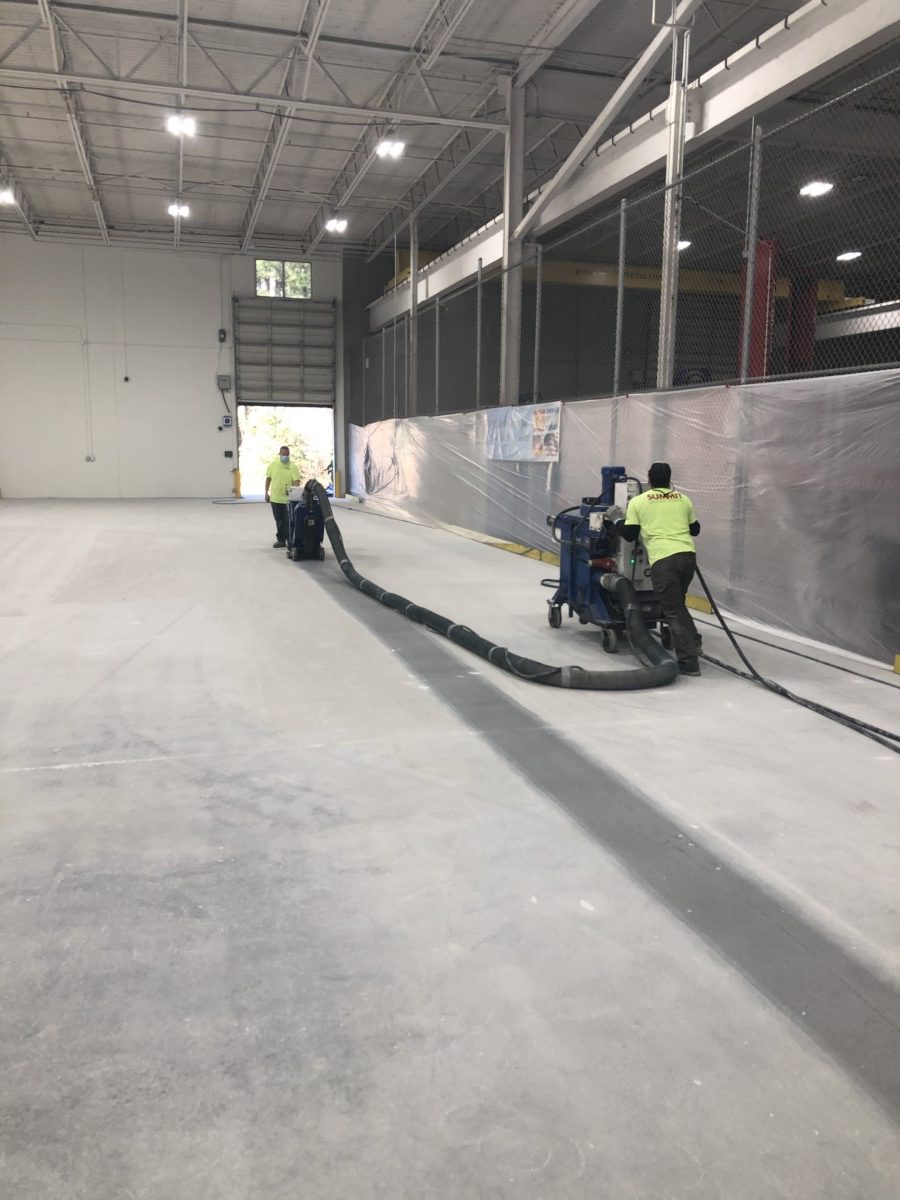
Based on the assessment, we select the appropriate method:- Shot blasting: Best for large, open areas. Highly efficient for removing coatings and creating profile.
- Diamond grinding: Ideal for edges, around equipment, and areas requiring precise control.
- Scarifying: For heavy coating removal or aggressive profiling needs.
Step 3: Contamination Removal
We grind until clean concrete is exposed in contaminated areas. We verify with adhesion tests—if the coating won’t stick in a test patch, we keep grinding.Step 4: Repair Work
Cracks are routed and filled with appropriate materials. Spalls and damaged areas are repaired with cementitious or epoxy mortars, depending on the final system. All repairs are allowed to cure properly before coating.Step 5: Final Profile Verification
Before coating begins, we verify the surface profile meets specifications. We do adhesion tests in multiple areas. Only then do we proceed with the coating system.How to Ensure Your Contractor Does Prep Right
Getting bids for an industrial flooring project? Here’s how to tell if a contractor takes surface prep seriously:Questions to Ask:
- “Do you own your surface preparation equipment, or rent it?” Ownership indicates commitment to proper prep.
- “What surface profile will you achieve, and how will you verify it?” They should specify CSP and have a verification method.
- “How do you test for moisture?” Look for ASTM F2170 or F1869 references, not just “we check it.”
- “What happens if you find contamination during prep?” The right answer involves additional grinding, not “it’ll be fine.”
- “How long will surface prep take relative to the total project?” If prep isn’t at least 30-40% of the timeline, they’re probably rushing it.
Red Flags:
- Bid significantly lower than others (they’re cutting corners somewhere)
- “We can do it faster” promises
- Vague answers about prep methods
- No moisture testing included
- Acid etching proposed for industrial floors
The Bottom Line
The secret to a long-lasting industrial epoxy floor isn’t in the coating—it’s in the preparation. A $15/gallon epoxy applied to properly prepared concrete will outlast a $50/gallon product applied to a shortcut surface. When you’re investing in industrial flooring, don’t just ask about the coating system. Ask about the prep. Ask about the equipment. Ask about the process. The contractors who take prep seriously are the ones who build floors that last. That’s been our approach for 35 years. It’s why we’ve worked with companies like Pfizer, Toyota, Amazon, and GE—and why they keep coming back.Ready to discuss your industrial flooring project? Contact Summit Industrial Flooring for a consultation. We serve Ohio, South Carolina, North Carolina, and the surrounding Southeast region with full surface preparation and industrial coating services.
Key Points
Why is surface preparation the most critical factor in industrial epoxy floor longevity and why is it so frequently shortcut?
- Surface preparation determines the bond between the coating and the concrete’ at a mechanical level — the coating cannot perform beyond the adhesion its substrate allows. A premium coating product applied to inadequately prepared concrete will fail as predictably as a low-grade product applied to the same surface.
- Eighty percent of industrial epoxy floor failures trace back to inadequate surface prep’ in Summit Industrial Flooring’s 35-year field experience — a proportion that reflects how systematically this step is compromised under project cost and schedule pressure.
- Proper surface preparation consumes 40 to 60 percent of total project time’, a proportion that creates pressure on contractors competing on price and speed. A contractor who rushes prep saves significant time and labor cost — and passes the consequences to the client months later in the form of floor failure.
- The equipment required for proper mechanical surface prep is specialized and expensive’. Diamond grinders, shot blasters, and scarifiers represent substantial capital investment that many contractors avoid through rental — which in turn creates pressure to complete prep quickly before daily rental costs accumulate.
- The visual impact of surface preparation is invisible in the finished floor’, making it the easiest step to shortcut without immediate detection. Clients see the shiny new coating; they cannot see the profile beneath it. This asymmetry of visibility creates the conditions for systematic corner-cutting.
- Contractors who own their surface preparation equipment remove the economic pressure’ that drives rushing. Summit Industrial Flooring’s ownership of all preparation machinery means no rental clock is running — the prep takes as long as it takes, regardless of schedule.
What does proper mechanical surface profiling involve and why is acid etching an inadequate substitute for industrial applications?
- Mechanical surface profiling creates the microscopic roughness that epoxy coatings require for long-term adhesion’. Diamond grinding and shot blasting physically abrade the concrete surface to a specific roughness level — the concrete surface profile — that gives the coating mechanical grip rather than relying on chemical adhesion alone.
- The industry standard for most industrial epoxy systems is a CSP of 3 to 4′, which creates a surface texture that allows the coating to penetrate into the concrete’s pores and lock mechanically to the substrate. This level of profile cannot be achieved without mechanical preparation equipment.
- Acid etching achieves only a CSP of 1 to 2′ — insufficient for industrial epoxy applications regardless of the product’s adhesion specifications. Acid etching is faster, cheaper, and requires no specialized equipment, which is why contractors use it — but it consistently produces adhesion failures under the demands of industrial environments.
- Shot blasting is the most efficient method for large open areas’, removing existing coatings and creating consistent profile across broad floor surfaces with high throughput. Diamond grinding is preferred for edges, areas around equipment, and situations requiring precise control of the removal depth and profile.
- Scarifying is used for heavy coating removal and aggressive profiling’ where shot blasting alone is insufficient — particularly for thick existing coatings or severely contaminated surfaces that require more material removal than shot blasting can achieve.
- Surface profile verification before coating application’ — not assumption that the right profile has been achieved — is a non-negotiable professional standard. Adhesion tests in multiple areas confirm that the prepared surface will actually hold the coating system before the investment in coating materials and labor is committed.
How do concrete contamination and moisture create epoxy floor failure and what does proper remediation require?
- Industrial concrete floors accumulate contaminants — oils, greases, chemicals, and tire compounds — that penetrate deep into the concrete’s pore structure’ over years of operation. Surface degreasing does not reach these embedded contaminants, which remain active barriers to adhesion even after the surface appears clean.
- Contaminated areas must be mechanically ground down until clean, uncontaminated concrete is exposed’. Adhesion testing in contaminated zones confirms whether sufficient material has been removed — if the test coating fails to adhere, grinding continues until it passes. There is no chemical shortcut that achieves the same result.
- In severe contamination cases, affected sections may require cutting out and replacement’ with cementitious patching compounds before coating can proceed. This is a more disruptive and expensive remediation than grinding, but applying coating over heavily contaminated concrete produces a failed floor regardless of every other preparation step performed correctly.
- Moisture vapor transmission is the failure mechanism that most surprises facility managers’ because it is invisible at the time of installation. Concrete releases moisture vapor continuously; when that vapor cannot escape through a sealed epoxy coating, it accumulates beneath the coating and generates pressure that causes bubbling, blistering, and delamination.
- ASTM F2170 relative humidity testing and ASTM F1869 calcium chloride testing are the industry-standard methods’ for quantifying moisture vapor transmission — not the informal plastic sheet test that many contractors substitute. Without ASTM-standard testing, moisture levels are guessed rather than measured.
- When moisture vapor transmission exceeds the coating system’s tolerance, a moisture mitigation system must be installed’ before coating proceeds. This adds cost and schedule time — but the alternative is a floor that fails within months at a cost that dwarfs the mitigation investment.
Why does Summit Industrial Flooring’s equipment ownership model produce better outcomes than contractors who rent preparation equipment?
- Rental economics create direct pressure to rush surface preparation’. Daily rental fees for shot blasters, diamond grinders, and scarifiers accumulate with every hour of use — creating a financial incentive to complete prep quickly and move to coating application, regardless of whether the surface has actually reached the required profile.
- Equipment ownership eliminates the rental clock entirely’, allowing the preparation to take exactly as long as the job requires. If additional grinding is needed, there is no cost penalty for continuing — only the professional obligation to produce the correct result.
- Summit’s crews operate their own equipment every day’, which produces operator expertise that rental equipment users cannot match. Knowing how a specific machine performs on a specific concrete composition, at a specific speed, to achieve a specific profile is knowledge that accumulates through repetition and is not available to crews using unfamiliar rental equipment.
- Owned equipment is available immediately when additional preparation work is identified during a project’. When contamination is found during grinding, or when moisture testing reveals a problem requiring additional prep, Summit can respond without the delay of sourcing, scheduling, and transporting rental equipment.
- Equipment ownership also reflects and reinforces a quality commitment’ that clients can evaluate as a proxy for overall professional standards. A contractor who has invested in their own preparation machinery has made a capital commitment to doing the prep correctly — a commitment that contractors who rent have explicitly avoided.
- The correlation between equipment ownership and project longevity’ across Summit’s 35-year history, and the client list that includes Pfizer, Toyota, Amazon, and GE, is the most direct evidence available that the ownership model produces floors that perform as specified across demanding industrial environments.
What does Summit Industrial Flooring’s complete surface preparation process look like from assessment through final verification?
- Assessment before any equipment touches the floor establishes the preparation plan’ based on actual conditions rather than assumptions. Assessment covers concrete age and composition, existing coatings and treatments, contamination types and severity, moisture levels via ASTM testing, crack and joint conditions, and floor flatness and levelness — each factor informing a specific preparation decision.
- Mechanical preparation method is selected based on assessment findings’, not defaulted to a single approach regardless of conditions. Shot blasting for large open areas, diamond grinding for edges and equipment surrounds, and scarifying for heavy coating removal each address specific preparation needs that a one-size-fits-all approach cannot accommodate.
- Contamination removal continues until adhesion testing confirms clean concrete’, not until the surface looks clean to visual inspection. The adhesion test — applying a test patch of coating and evaluating its bond — provides objective confirmation rather than subjective judgment.
- Crack routing, cleaning, and filling with compatible repair materials’ addresses the failure points that unrepaired cracks would otherwise create in the finished floor. Joint treatment is specified according to joint type — some joints are filled, others must remain functional — because applying the wrong treatment to a joint creates a failure point rather than resolving one.
- Repairs are allowed to cure fully before coating proceeds’, removing the cure-time pressure that leads contractors to coat over insufficiently cured repairs that subsequently fail and telegraph through the coating system.
- Final profile verification and adhesion testing across multiple areas of the floor’ confirm that the prepared surface meets specifications before coating investment is committed. This final checkpoint protects both the coating system and the client’s investment by ensuring that the preparation foundation is confirmed rather than assumed.
What should facility managers and procurement teams look for when evaluating industrial flooring contractors on surface preparation capability?
- Equipment ownership versus rental is the single most revealing question’ about a contractor’s commitment to proper preparation. The contractor who owns their shot blasters and diamond grinders has made a capital investment in doing the work correctly; the contractor who rents has preserved flexibility at the expense of that commitment.
- Specific CSP targets and verification methods’ should be stated in writing in any proposal for industrial epoxy flooring. A contractor who cannot specify the concrete surface profile they will achieve — or who cannot explain how they will verify it — has not internalized the preparation standards that determine floor longevity.
- ASTM-standard moisture testing should be included in the scope of work’ as a named deliverable, not a general assurance that moisture will be checked. Contractors who reference ASTM F2170 or F1869 by name understand the standard; contractors who describe their method as a “quick check” or “plastic sheet test” do not.
- The preparation timeline as a percentage of total project time’ provides a structural indicator of how seriously prep is being taken. If surface preparation is not allocated at least 30 to 40 percent of the total project schedule in a proposal, the contractor is planning to rush it — and the floor will reflect that decision within months.
- Significantly lower bids than the competitive field’ should trigger scrutiny rather than selection. In industrial flooring, price variance almost always reflects preparation scope variance — the cheaper bid is typically cheaper because less preparation is planned, not because of legitimate efficiency advantages.
- References from clients in similar industrial environments’ — manufacturing, food processing, warehousing, pharmaceutical — provide the most relevant evidence of preparation quality because these environments impose the conditions under which preparation shortcuts fail fastest. A contractor with a strong reference list from demanding industrial clients has produced floors that held up where corners cannot be hidden.
4 comments on “Why Industrial Epoxy Floors Fail: The Surface Prep Secret Nobody Talks About”